
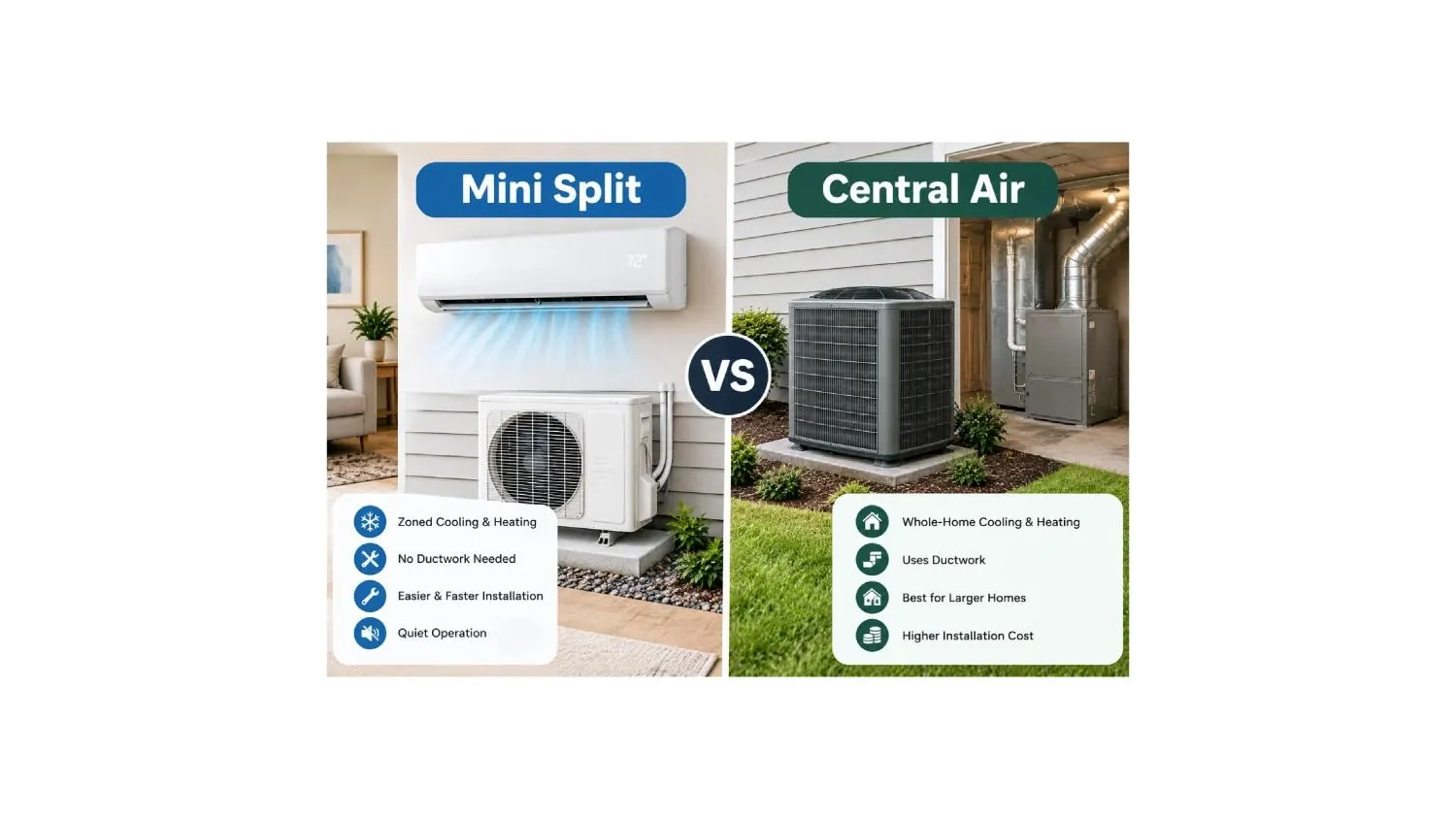
Mini Split vs Central Air: Costs, Pros, Cons and Which Is Better
If you need a new cooling system, you’ll probably end up choosing between a mini split and central air. Both can keep your home cool, but they work in very different ways. Central air sends cool air through hidden ducts to every room. A mini split cools rooms directly with small units on the wall, with no ducts at all. The right choice depends on your home, your budget, and how you use your space.
In this guide, we compare mini split vs central air in plain, simple words. First, we’ll explain what a mini split is and how each system works. Then we’ll look at latest costs, energy use, comfort, looks, and upkeep side by side. We’ll also answer common questions, like why some mini split bills run high and what the “$5,000 rule” means. By the end, you’ll know which system makes the most sense for your home.
Quick answer: Choose central air if your home already has good, sealed ductwork and you want hidden equipment that cools every room evenly. It usually costs about $5,000 to $7,000 installed when ducts are already in place. Choose a mini split if your home has no ducts or old, leaky ones, if you want room-by-room control, or if you’re cooling an addition, garage, or attic room. A single-zone mini split often costs about $2,000 to $8,000, and mini splits are usually more energy efficient because they don’t lose air through ducts.
What Is a Mini Split?
So, what is a mini split, exactly? A mini split (also called a ductless mini split or a mini split air conditioner) is a cooling system with two main parts:
- An outdoor unit with a compressor, like a small central AC unit.
- One or more indoor units (called air handlers or “heads”) that usually mount high on a wall. Some styles mount in the ceiling or near the floor.
The two parts connect with a thin bundle of copper refrigerant lines, a power cable, and a drain line. These pass through a small hole in the wall, about 3 inches wide. Each indoor unit cools the room it’s in and has its own remote or thermostat, so every room (or “zone”) can be set to a different temperature.
Most mini splits sold today are actually heat pumps. That means they can cool in summer and heat in winter. One outdoor unit can usually run anywhere from one to eight indoor units, depending on the model.
What Is a Ducted Mini Split?
There’s also a “ducted” mini split. It hides a small air handler in an attic, closet, or ceiling and uses short ducts to reach a few rooms. It’s a middle ground: more hidden than wall units, but more efficient than a big central system with long duct runs.
What Is Central Air?
To understand mini split vs central air, you also need to know how central air works. Central air conditioning uses one outdoor unit and one indoor unit (an air handler or furnace with a cooling coil). The indoor unit blows cool air through a network of ducts hidden in your walls, ceilings, or floors. Air comes out of vents in each room. One thermostat usually controls the whole house.
Fun fact: central air is technically a “split system” too, because the compressor sits outside and the cooling coil sits inside. The word “mini split” just means a smaller, usually ductless version. Central air is the most common cooling system in American homes, especially in homes that already have a furnace and ducts. If you pair it with a heat pump instead of a standard AC, it can also heat your home.
Mini Split vs Central Air: Quick Comparison
Here’s a side-by-side look at mini split vs central air before we go into the details.
| Feature | Mini split | Central air |
|---|---|---|
| Ductwork | Not needed | Required |
| Installed cost | About $2,000 to $8,000 per single zone; often $10,000 to $18,000+ for a whole home | About $5,000 to $7,000 with good ducts; up to $18,000 more if new ducts are needed |
| Energy efficiency | Very high; often 20+ SEER2, up to about 35 SEER2 | Mid-range; most 14 to 18 SEER2, top models around 26 |
| Duct energy loss | None | Often 20% to 30% |
| Temperature control | Room by room (zones) | Usually one temperature for the whole house |
| Heating | Most are heat pumps that heat and cool | Cooling only, unless paired with a furnace or heat pump |
| Looks | Indoor units are visible on walls | Hidden; only vents show |
| Noise | Very quiet indoors | Some blower and duct noise |
| Air filtration | Basic filters in each unit | Better whole-home filtration; can add air purifiers and humidifiers |
| Installation | Usually 1 to 3 days; small wall hole | 1 to 3 days with ducts; much longer if adding ducts |
| Lifespan | About 15 to 20 years | About 15 to 20 years |
| Best for | Homes without ducts, additions, single rooms, zoning | Homes with good ducts, open floor plans, whole-house comfort |
Efficiency figures are typical ranges from manufacturer and industry data.
Mini Split vs Central Air Cost
Cost is often what settles the mini split vs central air question. The answer depends mostly on one thing: whether you already have good ductwork.
| System | Typical installed cost |
|---|---|
| Single-zone mini split (one room) | About $2,000 to $8,000 |
| Multi-zone mini split (several rooms) | Often $10,000 to $18,000 or more |
| Central air with existing, good ducts | About $5,000 to $7,000 |
| Central air with new ductwork | Ducts alone can add up to about $18,000 |
| Duct cleaning (central air) | About $300 to $600 |
| Professional tune-up (either system) | About $150 to $300 |
Typical installed cost ranges. Prices vary by brand, home size, and region.
What this means for you:
- Home with good ducts: Central air is usually cheaper to install for the whole house.
- Home with no ducts: A mini split is usually much cheaper and less messy than adding ducts.
- Just one or two rooms: A single-zone or two-zone mini split is almost always the better deal.
Rebates and Incentives
Many states and utilities offer rebates for high-efficiency heat pumps, including mini splits. For example, some state energy-efficiency programs offer rebates and 0% financing on qualifying mini split heat pumps, but no rebate for replacing a standard central AC. Federal heat pump tax credits ended for systems installed after 2025, so check your state and local utility for current offers before you buy.
Energy Efficiency and Electric Bills
When it comes to running costs, mini split vs central air usually tilts toward the mini split. Here’s why:
- No duct losses. ENERGY STAR estimates that typical ducts lose 20% to 30% of the air moving through them through leaks, holes, and poor connections. Mini splits have no ducts, so none is lost.
- Inverter compressors. Most mini splits speed up and slow down to match what the room needs, instead of switching fully on and off. That saves energy and keeps temperatures steady.
- Zoning. You only cool the rooms you’re using. Central air usually cools the whole house, even empty rooms.
- Higher ratings. Many mini splits are rated 20 SEER2 or higher, and some reach about 35 SEER2. Most central systems fall in the mid-teens, with top models around 26.
What Does SEER2 Mean?
SEER2 stands for Seasonal Energy Efficiency Ratio, the updated version of the rating used since 2023. It measures how much cooling a system delivers for each unit of electricity over a typical cooling season. The higher the number, the less it costs to run. A system rated 20 SEER2 uses roughly a quarter less electricity than one rated 15 SEER2 for the same cooling. Many central air systems still use single-speed compressors that switch fully on and off, while most mini splits use variable-speed “inverter” compressors, which is a big part of why their ratings are higher.
As a rough example, a home with a $100 monthly summer cooling bill on central air might pay about $60 to $80 with a mini split. Your results will depend on your climate, home, and habits.
Why Is My Electric Bill So High With a Mini Split?
Mini splits are efficient, but some owners are surprised by their bills. Common reasons include:
- You’re now heating with electricity. If your mini split replaced gas or oil heat, your electric bill goes up even though your total energy bill may go down.
- The system is oversized. Too big a unit turns on and off too often (short cycling), which wastes energy.
- Dirty filters or coils. Each indoor unit has its own filter, and clogged filters make the system work harder.
- Frequent big temperature changes. Mini splits work best when you set a steady temperature and leave it.
- Very cold weather. In freezing temperatures, older or non-cold-climate models lose efficiency and may use backup heat.
- Running every zone all day. Zoning only saves money if you turn off or set back rooms you aren’t using.
Comfort and Temperature Control
Mini splits let each person set their own room. That’s great for a home office that gets hot, a bedroom where someone likes it cold, or a sunroom. Many mini splits also dehumidify well and run very quietly.
Central air keeps the whole house at one even temperature. Many HVAC pros also say central systems usually dehumidify a whole house better, because they move a large volume of air over one big coil. That matters in humid climates. In a big, open home, that can feel more natural. However, rooms far from the air handler or above a garage may run warmer. Adding zoning to central air is possible, but it costs extra.
Looks and Noise
The biggest complaint about mini splits is how they look. The indoor units are visible on your walls, and some people don’t like them in living rooms. Ceiling cassette and floor-mounted styles can help, as can a ducted mini split hidden in a closet or attic.
Central air hides almost everything. You only see the vents and the thermostat. On noise, mini splits are usually quieter indoors, since there’s no big blower pushing air through ducts.
Air Quality
Air quality is one area where the mini split vs central air comparison favors central air. Central air usually wins on air quality. Its single, larger filter cleans air for the whole house, and it’s easy to add upgrades like a high-MERV filter, UV light, whole-home air purifier, humidifier, or dehumidifier. Mini splits have small washable filters in each indoor unit. They catch dust but don’t filter the whole home as well. You can add a portable air purifier if needed.
Installation
Mini split installation is usually quick and clean. Installers drill one small hole per indoor unit and run lines to the outdoor unit, which can sit up to about 50 feet away. Many single-zone jobs take a day.
Central air installation is easy if your ducts are in good shape. Replacing an old central AC with a new one is often a one-day job. But if your home has no ducts, adding them means opening walls and ceilings, which takes time and money.
Maintenance and Lifespan
Upkeep is fairly even in the mini split vs central air matchup, but the tasks are different.
| Task | Mini split | Central air |
|---|---|---|
| Filters | Clean each indoor unit’s filter every few weeks to monthly | Replace one filter every 1 to 3 months |
| Coils and drains | Clean indoor coils and drain lines yearly (more units means more to clean) | Clean indoor and outdoor coils yearly |
| Ducts | None | Inspect and seal; clean every few years |
| Tune-up | Yearly, about $150 to $300 | Yearly, about $150 to $300 |
| Lifespan | About 15 to 20 years | About 15 to 20 years |
| Compressor warranty | Often 7 to 12 years | Often 10 years |
Adding AC to a Home With Heat-Only Ducts
This situation changes the mini split vs central air math. Many older homes have ducts for a furnace but no central AC. You might think adding central air is an easy upgrade, but check one thing first: are the ducts insulated?
Watch out: Cold air moving through uninsulated ducts in a hot attic or crawl space causes condensation. That moisture can lead to mold, mildew, and rot in your home.
A facilities director with several trade licenses put it simply: if your ducts are already insulated, there’s little reason to choose mini splits over central air. If they aren’t insulated, or you only need to cool part of the house, that’s where mini splits shine, because they’re often cheaper and easier than insulating and sealing all the ductwork.
A Third Option: High-Velocity Small-Duct Systems
If you want central air in an older home but don’t have room for standard ducts, ask about a high-velocity system. These use small, flexible ducts (about 2 inches wide) that can be snaked through walls, closets, and between floors with very little demolition. Air comes out of small round outlets instead of big vents. They usually cost more than standard central air, but they keep the equipment hidden, unlike wall-mounted mini split heads.
Mini Split vs Window AC
If you’re only cooling one room, you may also be comparing a mini split air conditioner with a window unit.
| Feature | Mini split | Window AC |
|---|---|---|
| Upfront cost | About $2,000 to $8,000 installed | Often a few hundred dollars |
| Efficiency | Much higher; often 20+ SEER2 | Much lower |
| Noise | Very quiet indoors | Noticeably loud |
| Heating | Most heat very well | Usually cooling only |
| Installation | Permanent; pro install | DIY; can move it |
| Window use | Leaves windows free | Blocks a window |
Window units are cheap and easy, but a mini split is quieter, far more efficient, and doubles as a heater. It’s also a great fix for one room that the central system never heats or cools well.
Mini Split vs Central Air Pros and Cons
Mini Split Pros
- No ducts needed
- Very energy efficient
- Room-by-room temperature control
- Heats and cools (most models)
- Quiet and quick to install
- Great for additions, garages, attics, and older homes
Mini Split Cons
- Visible indoor units
- Can cost more than central air for a whole home with existing ducts
- Each indoor unit needs its own cleaning (cleaning kits, line covers, and wall brackets add small extra costs)
- Less whole-home air filtration
- Large open spaces may need more than one unit
Central Air Pros
- Hidden equipment; only vents show
- Even cooling for the whole home
- Usually cheaper if ducts already exist
- Better whole-home filtration and air quality add-ons
- One simple thermostat
Central Air Cons
- Energy loss through ducts
- Very expensive if you need new ductwork
- Cools empty rooms too
- Ducts need cleaning and sealing
- Uneven temperatures in some rooms
Which Should You Choose?
The mini split vs central air choice usually comes down to your home’s ducts and how you live in your space.
Choose a mini split if:
- Your home has no ductwork, like many older homes and some mobile homes.
- Your ducts are old, leaky, or in a hot attic.
- You’re adding a room, finishing a basement or attic, or cooling a garage or sunroom.
- Family members want different temperatures in different rooms.
- You want one system for efficient heating and cooling.
Choose central air if:
- Your home already has good, well-sealed ductwork.
- You want hidden equipment and an even temperature everywhere.
- You have a large, open floor plan.
- Air quality add-ons, like whole-home filtration, matter to you.
Mixing Both
Many homeowners use both. Central air handles the main house, and a mini split covers a hot bonus room, addition, or garage. This “hybrid” approach can fix problem rooms without replacing your whole system.
Mini Split vs Central Air for Special Cases
- Older homes: Mini splits are often the easiest way to add AC without tearing into plaster walls. Many old-house owners say they’re the best option for homes built without ducts.
- Mobile homes: Mini splits work well because they need no ducts and take little space. If your mobile home already has working ducts, a packaged central system may cost less.
- New builds: Either works. With new construction, ducts are easier to add, so central air or a ducted mini split is common. Ductless units are a good choice for highly efficient, well-sealed homes.
- Mini split vs central air vs heat pump: A heat pump isn’t a separate category. Most mini splits are heat pumps, and central air can also be a heat pump. The real question is ducted or ductless.
What Is the $5,000 Rule for HVAC?
The $5,000 rule is a quick way to decide whether to repair or replace your HVAC system. Multiply the age of your system by the repair cost. If the number is more than $5,000, replacement is usually the better deal.
Example: A 12-year-old central AC with a $500 repair gives you $6,000, so it may be time to replace it. When you do, that’s a great time to compare mini split vs central air for your home.
Are Mini Splits the Future of HVAC?
Mini splits and heat pumps are growing fast in the U.S. In recent years, heat pumps have outsold gas furnaces, and more homeowners are choosing ductless systems for efficiency and zoning. Improved cold-climate models now heat well even in freezing weather. That said, central air isn’t going away. In homes with good ductwork, it’s still a smart, cost-effective choice, and central heat pumps offer many of the same efficiency benefits.
Frequently Asked Questions
What is a mini split?
A mini split is a ductless heating and cooling system with an outdoor unit and one or more indoor wall units connected by small refrigerant lines. Each indoor unit controls the temperature in its own room or zone.
Is a mini split cheaper than central air?
For one or a few rooms, yes. For a whole house that already has good ducts, central air is usually cheaper to install. Mini splits are usually cheaper to run because they don’t lose energy through ducts.
What is the disadvantage of a mini split?
The main downsides are visible indoor units, higher upfront cost for whole-home setups, more filters to clean, and less whole-home air filtration than central air.
Can a mini split cool a whole house?
Yes. A multi-zone mini split can cool a whole house with several indoor units connected to one or more outdoor units. Open layouts and large homes may need careful planning or more than one outdoor unit.
Do mini splits use less electricity than central air?
Usually, yes. Mini splits avoid duct losses, use variable-speed inverter compressors, and let you cool only the rooms you use. Many owners see lower cooling bills.
How long does a mini split last compared with central air?
Both usually last about 15 to 20 years with regular maintenance.
Is a mini split air conditioner good for heating?
Most mini split air conditioners are heat pumps that also heat. Cold-climate models can heat efficiently even when it’s well below freezing outside.
Can I add central air to my existing furnace ducts?
Often, yes. But the ducts must be properly sized and insulated, especially in attics and crawl spaces. Uninsulated ducts carrying cold air can sweat and cause mold and rot. If your ducts need major work, a mini split may be cheaper.
Is a mini split better than a window AC?
A mini split is much quieter, far more efficient, and usually heats as well as cools. A window AC is much cheaper upfront and easy to move, so it can make sense for a short-term or very tight budget.
Which dehumidifies better, a mini split or central air?
Central air usually dehumidifies a whole house better because it moves a large amount of air over one big coil. Many mini splits have a “dry” mode that works well for individual rooms.
Final Verdict: Mini Split vs Central Air
There’s no single winner in the mini split vs central air debate. If your home has good ducts and you want hidden, whole-house cooling, central air is usually the simplest and most cost-effective choice. If your home has no ducts, you need to cool just a few rooms, or you want the best energy efficiency and room-by-room control, a mini split is hard to beat.
Start by checking the condition of your ducts and thinking about how you use each room. Then get quotes for both systems from licensed HVAC contractors, and ask about local rebates. With the right choice, you’ll stay comfortable and keep your energy bills in check for years to come.