Best Flooring for Basements: 9 Top Options Compared
Finishing a basement is one of the best ways to add living space to your home, but the floor can make or break the project. Basements sit below ground, so the concrete slab can pull up moisture, the air is often damp, and leaks or floods are always possible. The wrong flooring can warp, grow mold, smell musty, or need to be torn out after one wet season. The right flooring shrugs off moisture, feels comfortable, and looks great for years. The trick is matching the floor to how dry your basement is and how you plan to use it.
In this guide, we compare the best flooring for basements in plain, simple words. You’ll see our top 9 picks side by side, with the pros, cons, cost, and best use for each one. We’ll show you how to test your concrete for moisture, which subfloor options keep floors dry and warm, and which flooring you should avoid. You’ll also find the best choice for a basement that floods, a home gym, a playroom, and a cold basement. By the end, you’ll know exactly which basement floor fits your space, budget, and moisture level.
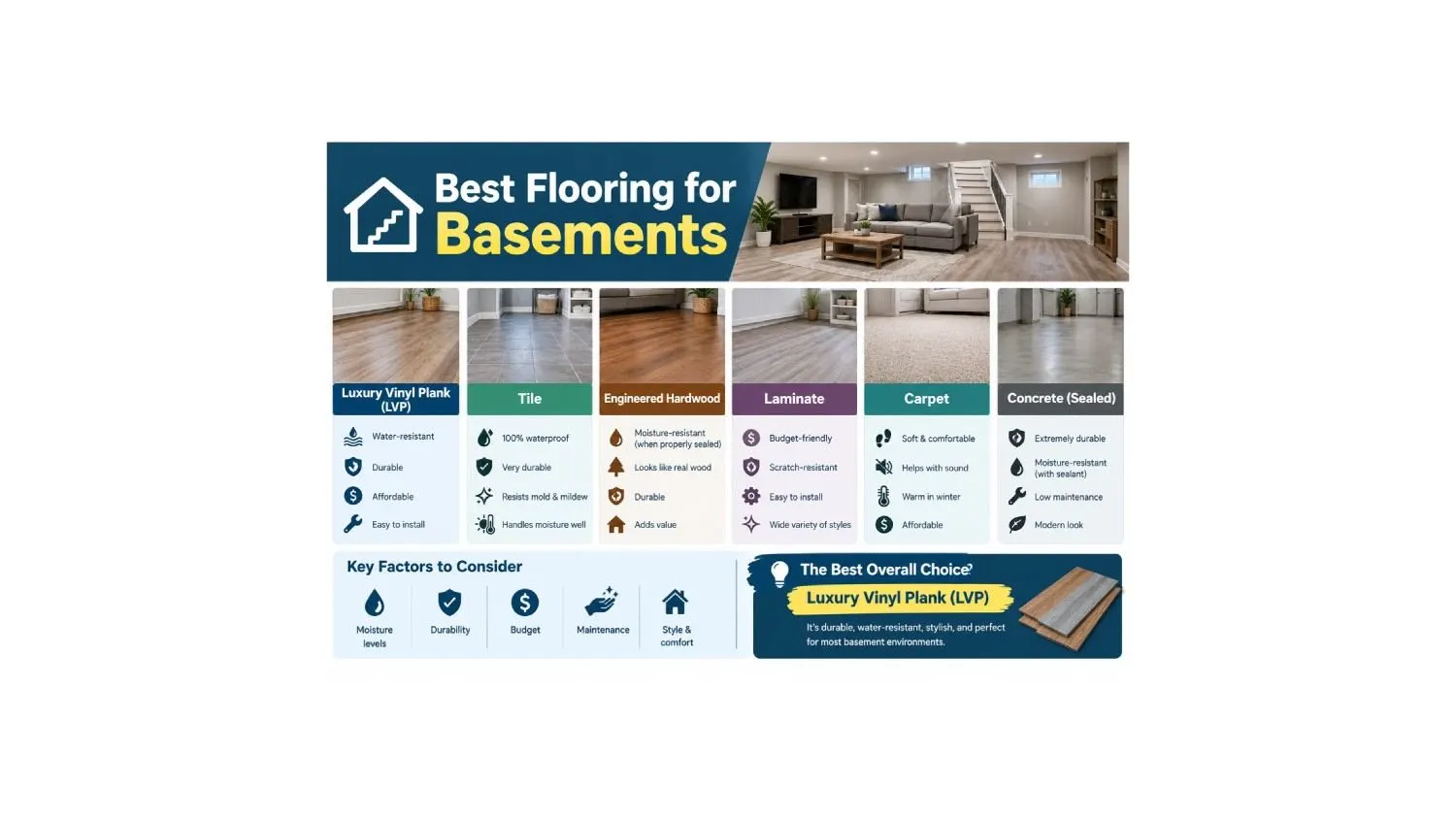
Quick answer: Luxury vinyl plank (LVP), especially rigid core vinyl, is the best overall flooring for most basements. It’s waterproof, approved for below-grade use, looks like wood, feels warmer than tile, and is easy to install. Porcelain tile is best for basements that get wet or flood. Sealed or epoxy-coated concrete is the best budget and utility option. Whatever you choose, fix any water problems first and test the slab for moisture before you install.
Why Basement Flooring Is Different
A basement floor faces challenges that upstairs floors never see:
- Moisture from below: Concrete is porous. Water vapor from the ground can move up through the slab and get trapped under flooring.
- Humidity: Basements are cool and often damp, which can lead to mold, mildew, and musty smells.
- Leaks and floods: Heavy rain, a failed sump pump, a burst pipe, or a leaking water heater can put water on the floor.
- Cold: Concrete stays cool year-round, so basement floors often feel cold underfoot.
- Uneven slabs: Many basement floors have cracks, dips, and slopes toward a floor drain.
- Low ceilings: Every inch of flooring and subfloor takes away headroom.
That’s why the best flooring for basements has to handle moisture first, then comfort and looks.
Step One: Fix Water Problems Before Choosing Flooring
Choosing the best flooring for basements starts with the water, not the floor. As one homeowner put it simply, if your basement floods, fix the flooding first and worry about decorating later. No flooring can solve a water problem. It can only hide it while mold grows underneath.
Common fixes include:
- Cleaning gutters and extending downspouts at least 4 to 6 feet from the house
- Grading soil so it slopes away from the foundation, about 6 inches of drop over the first 10 feet
- Sealing cracks in walls and floors
- Installing or upgrading a sump pump, ideally with a battery backup
- Adding interior drain tile or exterior waterproofing for serious leaks
- Running a dehumidifier to keep humidity around 30% to 50%
Also test for radon. Radon is a natural radioactive gas that can seep through basement floors. The EPA recommends fixing your home if levels are 4 pCi/L or higher. Test before you cover the floor, since sealing the slab is often part of the fix.
How to Test Your Basement Floor for Moisture
Testing is how you narrow down the best flooring for basements in your home. Before you buy any flooring, find out how much moisture is coming through the concrete.
- Plastic sheet test (easy DIY): Tape down an 18-by-18-inch square of clear plastic on all four sides. Wait 16 to 24 hours, then lift it. If there’s water or dark, damp concrete under the plastic, moisture is coming up through the slab. If water beads on top of the plastic, the problem is humid air in the room.
- Calcium chloride test: A kit measures how much moisture the slab gives off over 60 to 72 hours.
- Relative humidity (RH) probe test: A small hole is drilled into the slab, and a probe measures moisture inside the concrete. Many pros consider this the most accurate test.
Every flooring maker sets its own moisture limits, so check your product’s installation guide. If your readings are too high, you’ll need a moisture barrier, a sealer, or a different floor.
Best Flooring for Basements: Our Top 9 Picks at a Glance
| Flooring | Water handling | Warmth | Installed cost (per sq ft) | Best for |
|---|---|---|---|---|
| Luxury vinyl plank (LVP) | Waterproof | Medium | About $4 to $10 | Best overall; living spaces |
| Porcelain or ceramic tile | Waterproof | Cold (unless heated) | About $8 to $20 | Wet or flood-prone basements |
| Sealed, stained, or polished concrete | Very water resistant | Cold | About $2 to $12 | Budget, utility, modern look |
| Epoxy coating | Waterproof surface | Cold | About $4 to $12 (pro) | Workshops, laundry, gyms |
| Waterproof laminate | Water resistant to waterproof top | Medium | About $3 to $8 | Budget wood look; dry basements |
| Engineered hardwood | Moisture-stable, not waterproof | Warm | About $6 to $16 | Dry basements; real wood look |
| Carpet tiles or carpet | Varies; tiles can be replaced | Warmest | About $3 to $8 | Family rooms, playrooms |
| Rubber flooring | Water resistant | Medium | About $3 to $12 | Home gyms, playrooms |
| Sheet vinyl | Waterproof | Medium | About $2 to $6 | Laundry rooms, tight budgets |
Rough national ranges. Prices vary by product, region, and how much slab prep is needed.
The 9 Best Basement Flooring Options, Compared
1. Luxury Vinyl Plank (LVP): Best Overall
Ask most flooring pros about the best flooring for basements, and luxury vinyl plank is the top answer. LVP is made of layers of vinyl with a printed design that looks like wood or stone and a clear wear layer on top. Many products are 100% waterproof and approved for installation below grade.
There are two main types:
- Rigid core (SPC or WPC): A stiff stone-plastic or wood-plastic core that hides small bumps in the slab, clicks together, and floats over the floor. This is the best choice for most basements.
- Flexible or glue-down LVP: Thinner and cheaper, but it shows bumps in the concrete more easily.
Pros:
- Waterproof planks that won’t swell or warp from spills
- Realistic wood and stone looks
- Warmer and softer than tile, especially with an attached pad
- DIY-friendly click-lock install, often right over concrete
- Floating planks can be pulled up, dried, and reused after a minor flood
- Scratch and stain resistant
Cons:
- Waterproof planks don’t stop water from getting under them at the edges; trapped water can cause mold if not dried
- Can dent under heavy furniture without pads
- Cheap products can look fake, and thin wear layers wear faster
- Can’t be refinished
Buying tips: Budget vinyl plank can cost as little as about $1.50 to $2 per square foot for materials, while thicker, rigid core planks with an attached pad often run about $3 to $5 or more. Many bargain planks have only a 6 mil wear layer, which is fine for light use but wears faster in a busy family room. Choose a wear layer of at least 12 mil for homes, and 20 mil for busy areas. Look for planks approved for below-grade use. If the plank has no attached pad, use the maker’s recommended underlayment with a built-in vapor barrier.
2. Porcelain or Ceramic Tile: Best for Wet and Flood-Prone Basements
When water is a real risk, tile is often the best flooring for basements. It’s the toughest option against water. Porcelain tile absorbs almost no water, and tile set directly on concrete can survive a flood with little more than a cleanup.
Pros: Truly waterproof, very durable, lasts decades, easy to clean, and comes in endless styles, including wood-look planks.
Cons: Cold and hard underfoot, grout lines need sealing and cleaning, costs more to install, and cracks in the slab can crack the tile.
Tips:
- Add electric radiant heat mats under the tile to solve the cold-floor problem.
- Use an uncoupling membrane over cracked slabs to help prevent tile cracks.
- A remodeler with 50 years of experience shared an old-school tip: for basements where water comes up from below, set quarry or porcelain tile with cement-based thinset and cement grout, and leave the grout unsealed so the slab can dry out after each wetting.
3. Sealed, Stained, or Polished Concrete: Best Budget Option
Sometimes the best flooring for basements is the floor you already have. Concrete can be cleaned, patched, sealed, stained, or polished into an attractive, modern floor.
Pros: Lowest cost, no risk of flooring rotting or warping, nothing to tear out after a flood, and easy to clean. Polished concrete looks sleek and lasts for decades.
Cons: Cold and hard, shows cracks and stains from the past, and can feel echoey. Sealers need to be reapplied every few years.
Tip: Add large area rugs to warm up living spaces. Choose a “breathable” penetrating sealer if moisture comes through your slab.
4. Epoxy Floor Coating: Best for Workshops, Laundry, and Gyms
Epoxy is a tough, glossy coating poured or rolled over concrete. It creates a seamless, waterproof surface that resists stains, chemicals, and wear.
Pros: Very durable, seamless, easy to clean, and available in colors and decorative flake finishes.
Cons: Cold and hard. Moisture coming up through the slab can make epoxy bubble and peel, so you need a moisture test and often a special moisture-blocking primer. Surface prep, like grinding the concrete, is critical.
Tip: If you resurface old, cracked concrete with a fresh thin layer first, let it cure fully, often about 4 weeks, before applying epoxy.
5. Waterproof Laminate: Best Budget Wood Look
Standard laminate has a fiberboard core that swells when wet, which makes it a poor basement choice. Newer “waterproof” or “water-resistant” laminates use sealed edges and moisture-resistant cores to handle spills much better.
Pros: Affordable, very scratch-resistant, realistic wood looks, and easy click-lock install.
Cons: Not all laminate is truly waterproof; many products only resist water for a set number of hours. The core can still swell if water sits under it.
How to install in a basement: Always use an underlayment with a vapor barrier, or lay 6-mil plastic sheeting first, because concrete can push moisture into the bottom of the planks and cause mold. You can also install it over a raised subfloor.
Best for: Dry basements with good moisture test results.
6. Engineered Hardwood: Best Real Wood Option
If you want real wood in your basement, engineered hardwood is the only wood floor most makers approve below grade. Its cross-layered core makes it much more stable than solid wood.
Pros: Real wood beauty, warmer feel, adds value, and can be glued down or floated over concrete.
Cons: Not waterproof; a flood will likely ruin it. It costs more and needs steady humidity.
Best for: Dry basements used as dens, game rooms, or offices. Use prefinished planks and area rugs in high-traffic spots. Never install solid hardwood directly in a basement; it will cup and warp.
7. Carpet and Carpet Tiles: Best for Warmth and Comfort
Carpet makes a basement feel cozy, quiet, and warm, which is why it’s popular for family rooms, media rooms, and kids’ play areas.
Pros: Warmest and softest option, absorbs sound, and is fairly affordable.
Cons: Traditional wall-to-wall carpet and padding can trap moisture and grow mold, and usually must be thrown out after a flood.
Better choices for basements:
- Carpet tiles: Square tiles you can lift, dry, or replace one at a time if a spot gets wet.
- Synthetic fibers: Nylon, polyester, or olefin resist mold better than wool.
- Moisture-resistant padding or carpet with an attached waterproof backing.
- Install over a raised subfloor for added protection and warmth.
8. Rubber Flooring: Best for Home Gyms and Playrooms
For workout spaces, rubber is the best flooring for basements. It comes in rolls, tiles, and heavy mats. It’s the go-to choice for a basement workout area.
Pros: Absorbs impact, protects the slab from dropped weights, reduces noise, resists water, and is comfortable to stand on.
Cons: Some products have a rubber smell at first, and it isn’t the most stylish choice for living areas.
Tip: For a gym section, use rubber tiles or mats about ⅜ to ¾ inch thick. Thick rubber stall mats are a budget favorite for heavy lifting areas. You don’t need to cover the whole basement; a rubber-floored section of 8 by 10 feet or so is enough for most home workouts.
Foam tiles for play areas: Interlocking foam tiles, about ½ to ⅝ inch thick, are cheap, soft, and come in wood-grain looks. They’re great for kids’ playrooms and can be lifted to dry if they get wet, but they dent under furniture and aren’t meant for living rooms long term.
9. Sheet Vinyl: Best Budget Waterproof Option
Sheet vinyl comes in large rolls, so there are few or no seams for water to get through.
Pros: Low cost, waterproof, and easy to clean. Great for laundry rooms and utility areas.
Cons: Thin, so it shows bumps in the slab. It can tear and looks less high-end than LVP.
Waterproof vs. Water-Resistant: Know the Difference
| Feature | Waterproof | Water-resistant |
|---|---|---|
| What it means | The flooring material won’t be damaged by water | Resists spills for a limited time |
| Examples | Vinyl plank, porcelain tile, sheet vinyl, epoxy | Many laminates, engineered hardwood, some carpets |
| After a flood | Often can be dried and saved | Often must be replaced |
Remember: “Waterproof” means the plank won’t be ruined by water. It doesn’t mean water can’t get underneath it. Water can still collect under any floor and lead to mold if it isn’t dried quickly.
Flooring to Avoid in Basements
Knowing what to skip is just as important as knowing the best flooring for basements.
- Solid hardwood: Swells, cups, and warps from moisture below grade.
- Standard laminate without water protection: The fiberboard core swells and falls apart when wet.
- Wall-to-wall carpet with regular padding in a damp basement: Traps moisture and grows mold.
- Natural fiber rugs and wool carpet in damp areas: Absorb moisture and can mildew.
- Cork and bamboo floating floors in damp basements: They’re more sensitive to moisture than most makers’ marketing suggests.
Subfloor Options: Keep Your Basement Floor Dry and Warm
Even the best flooring for basements works better on a good base. A subfloor raises your new floor off the cold concrete, adds a moisture break, and makes the floor feel warmer. Here are the main options:
| Subfloor option | How it works | Height added | Rough cost |
|---|---|---|---|
| Underlayment with vapor barrier | Thin foam or felt roll with plastic film, under floating floors | About ⅛ inch | About $0.50 to $1 per sq ft |
| Dimpled plastic membrane | Waffle-shaped plastic sheet creates an air gap so moisture can escape | About ¼ to ⅜ inch (plus top panels) | About $1 to $2 per sq ft |
| Raised modular floor tiles | Plastic tiles with raised feet and drainage channels underneath; some have carpet or vinyl tops built in | About ½ to ¾ inch | About $2 to $7 per sq ft |
| Interlocking subfloor panels | Panels with wood or composite on top and a dimpled plastic or foam base | About ⅞ to 1 inch | About $1.50 to $4 per sq ft |
| Rigid foam insulation + plywood | Foam boards on the slab with plywood or OSB on top | About 1½ to 2 inches | About $2 to $4 per sq ft |
| Sleepers + plywood or OSB | Treated 2x4s laid flat on a sealed slab, topped with plywood or OSB | About 2¼ inches | About $2 to $4 per sq ft |
A real-world example: One homeowner who spent decades working with building materials spent about 15% of his basement budget on a raised, “floating” subfloor. He sealed all cracks along the wall-to-floor joint with concrete caulk, laid a dimpled plastic membrane, taped 6-mil plastic strips at the walls, screwed treated 2×4 sleepers to the slab 2 feet apart with sealant at each screw, and glued and screwed ¾-inch OSB on top. The result was a dry, warm, solid floor ready for any finish.
Watch your ceiling height. Building codes usually require about 7 feet of ceiling height in finished living spaces. In a low basement, a thick subfloor may not fit, so choose thinner systems or flooring that installs directly on concrete.
Tile vs. LVP for a Basement: Which Is Better?
This is one of the most common questions when choosing the best flooring for basements. Both are waterproof, but they suit different basements.
| Feature | Luxury vinyl plank | Porcelain tile |
|---|---|---|
| Water | Waterproof planks; water can get under floating floors | Waterproof; bonded to the slab, so water can’t hide underneath |
| Warmth and comfort | Warmer and softer | Cold and hard without radiant heat |
| Installation | Easy DIY; floats over minor bumps | Harder; needs a flat slab, thinset, and grout |
| Cost (installed) | About $4 to $10 per sq ft | About $8 to $20 per sq ft |
| Lifespan | About 15 to 25 years | Decades |
| After a flood | Can often be lifted, dried, and reinstalled | Usually just needs cleaning |
The verdict: LVP is the better choice for most finished basements, especially family rooms, bedrooms, and playrooms. Many homeowners who finished basements say they skipped porcelain downstairs, even when they love it upstairs, because vinyl is warmer and easier. Choose tile if your basement takes on water often or you want the longest-lasting floor.
What Type of Flooring Is Best Over Concrete?
Most basements are bare concrete, so the best flooring for basements is usually something that works right on the slab. When flooring goes straight onto a basement slab, the best choices are:
- Rigid core vinyl plank: Floats over concrete and hides small flaws.
- Porcelain tile: Bonds directly to clean, flat concrete.
- Polished, stained, or epoxy-coated concrete: Turns the slab itself into the finished floor.
- Glue-down or floating engineered hardwood: Only on dry slabs that pass moisture testing.
- Carpet tiles or raised modular tiles: Warm options that can be lifted if needed.
Before any of these, the slab should be clean, flat (most floors need it within about 3/16 inch over 10 feet), and tested for moisture.
Best Flooring for a Basement With Moisture
If your moisture test shows dampness coming through the slab, but you don’t have standing water, your best options are porcelain tile, sealed concrete, epoxy with a moisture-blocking primer, or rigid core vinyl plank over a vapor barrier underlayment. A dimpled membrane or raised modular subfloor adds an air gap that lets the slab breathe. Keep a dehumidifier running, and avoid carpet with padding, laminate, and wood.
Cheapest Ways to Cover a Concrete Basement Floor
| Option | Rough cost per sq ft | Notes |
|---|---|---|
| Concrete floor paint | About $0.50 to $2 (DIY) | Cheapest; use paint made for concrete floors; may peel if slab is damp |
| Concrete stain and sealer | About $1 to $3 (DIY) | Soaks in, so it won’t peel; looks modern |
| DIY epoxy kit | About $1 to $3 (DIY) | Tougher than paint; prep is key |
| Interlocking foam tiles | About $1.50 to $3 | Soft, removable; good for play areas |
| Budget vinyl plank | About $1.50 to $2.50 materials | Easy DIY; choose a thicker wear layer if you can |
| Sheet vinyl | About $1 to $3 materials | Few seams; good for laundry areas |
| Large area rugs over sealed concrete | Varies | Warm up living spaces for little cost |
Rough price ranges. Prices vary by product and region.
Best Flooring for Basements by Situation
Use this table to find the best match for your space.
| Your situation | Best choice |
|---|---|
| Dry basement, living space | LVP, engineered hardwood, or carpet over a subfloor |
| Basement that gets damp | Rigid core LVP or porcelain tile |
| Basement that floods | Porcelain tile, sealed concrete, or epoxy (and fix the water problem) |
| Cold basement or cold climate | LVP or carpet over an insulated subfloor, or tile with radiant heat |
| Home gym | Rubber tiles or mats |
| Kids’ playroom | LVP with area rugs, carpet tiles, or foam tiles |
| Laundry or utility room | Sheet vinyl, tile, epoxy, or sealed concrete |
| Workshop | Epoxy or sealed concrete |
| Tight budget | Sealed or painted concrete, sheet vinyl, or budget LVP |
| Rental or in-law suite | Rigid core LVP |
| Basement bedroom | LVP with area rugs, or carpet tiles over a subfloor (bedrooms also need a code-approved egress window) |
Best Flooring for Cold and Northern Basements
The best flooring for basements in cold climates needs extra warmth. In northern U.S. states and Canada, basement slabs stay chilly most of the year. To warm things up, install an insulated subfloor (rigid foam with plywood or subfloor panels), choose LVP with an attached pad or carpet tiles, or add radiant floor heat under tile or LVP that’s approved for it.
Design Tips for Basement Floors
- Go light in dark basements. Light-colored floors in soft grays, warm honey tones, or whitewashed wood make a windowless basement feel bigger and brighter.
- Your basement floor doesn’t need to match upstairs. It’s a separate space, so pick what works best below grade.
- Use area rugs to add warmth, comfort, and color in living areas.
- Run planks the long way in a room to make it feel larger.
- Use felt pads under heavy furniture to prevent dents in vinyl.
Frequently Asked Questions
What is the best flooring for basements?
Luxury vinyl plank, especially rigid core vinyl, is the best overall choice for most basements. It’s waterproof, approved for below grade, looks like wood, and installs easily. Porcelain tile is best for wet basements.
Why is vinyl plank the best flooring for basements?
Many vinyl planks are waterproof, easy to clean, durable, and approved for below-grade use. They also feel warmer and softer than tile. The concrete underneath still needs to be tested and prepared first.
What is the best flooring for a basement that gets wet?
Porcelain tile set directly on concrete, sealed or polished concrete, and epoxy coatings handle water best. Rigid core vinyl plank also works if water is occasional. Fix the source of the water first.
What is the cheapest way to cover a concrete basement floor?
Painting, staining, or sealing the existing concrete is the cheapest option, often under $2 per square foot DIY. Sheet vinyl and budget vinyl plank are other low-cost choices.
Is tile or LVP better for a basement?
LVP is better for most finished basements because it’s warmer, softer, cheaper, and easier to install. Tile is better for basements that get wet often or when you want the longest-lasting floor.
What type of flooring is best over concrete?
Rigid core vinyl plank, porcelain tile, and polished or epoxy-coated concrete are the best choices over a concrete slab. Engineered hardwood can work on dry slabs that pass moisture testing.
What type of flooring is best for a basement with moisture?
Porcelain tile, sealed concrete, epoxy with a moisture-blocking primer, or rigid core vinyl plank over a vapor barrier. Run a dehumidifier and avoid carpet, laminate, and wood.
Do I need a subfloor in my basement?
Not always. Vinyl plank, tile, and epoxy can go directly on a dry, flat slab. A subfloor is a good idea if your slab is cold, slightly damp, or uneven, or if you’re installing carpet or wood.
Can you put laminate flooring in a basement?
Yes, but only waterproof or water-resistant laminate in a dry basement. Always install a vapor barrier underlayment or a raised subfloor, because concrete can push moisture into the planks and cause mold.
Is carpet a good idea in a basement?
It can be in a dry basement. Carpet tiles with synthetic fibers are the safest choice, since you can remove and dry or replace damaged tiles. Avoid regular carpet and padding in damp basements.
Can you put hardwood floors in a basement?
Engineered hardwood can go in a dry basement. Solid hardwood is not recommended below grade because it swells and warps from moisture.
How do I keep my basement floor from feeling cold?
Install an insulated subfloor, choose vinyl plank with an attached pad or carpet, use area rugs, or add radiant floor heating under tile or approved vinyl.
Final Thoughts
The best flooring for basements is the one that matches your moisture level and how you use the space. For most homes, rigid core luxury vinyl plank is the top choice. It’s waterproof, comfortable, good-looking, and easy to install. Choose porcelain tile for basements that get wet, sealed concrete or epoxy for budget and utility spaces, and rubber for home gyms.
Before you buy anything, fix water problems, test the slab for moisture, and consider a subfloor if your concrete is cold or damp. Get these basics right, and your basement floor will stay dry, warm, and beautiful for many years.