Best Mulch for Vegetable Garden: 10 Top Choices Compared
Mulch is one of the easiest ways to grow better vegetables with less work. A good layer keeps the soil moist, blocks weeds, and keeps your tomatoes and squash off the dirt. But walk into any garden store, and you’ll see dozens of bags and bales, from straw to dyed wood chips. Some are great for vegetables, while others can slow your plants down or even add chemicals to your soil. Picking the wrong one can cost you time, money, and part of your harvest.
In this guide, we compare the best mulch for vegetable garden beds in plain, simple words. You’ll see our top 10 picks side by side, with the pros, cons, cost, and best use for each one. We’ll also show you which mulches to avoid, which mulch works best for tomatoes, and how deep to spread it. You’ll learn when to mulch, how much to buy, and the mistakes that trip up new gardeners. By the end, you’ll know exactly which mulch fits your garden, your crops, and your budget.
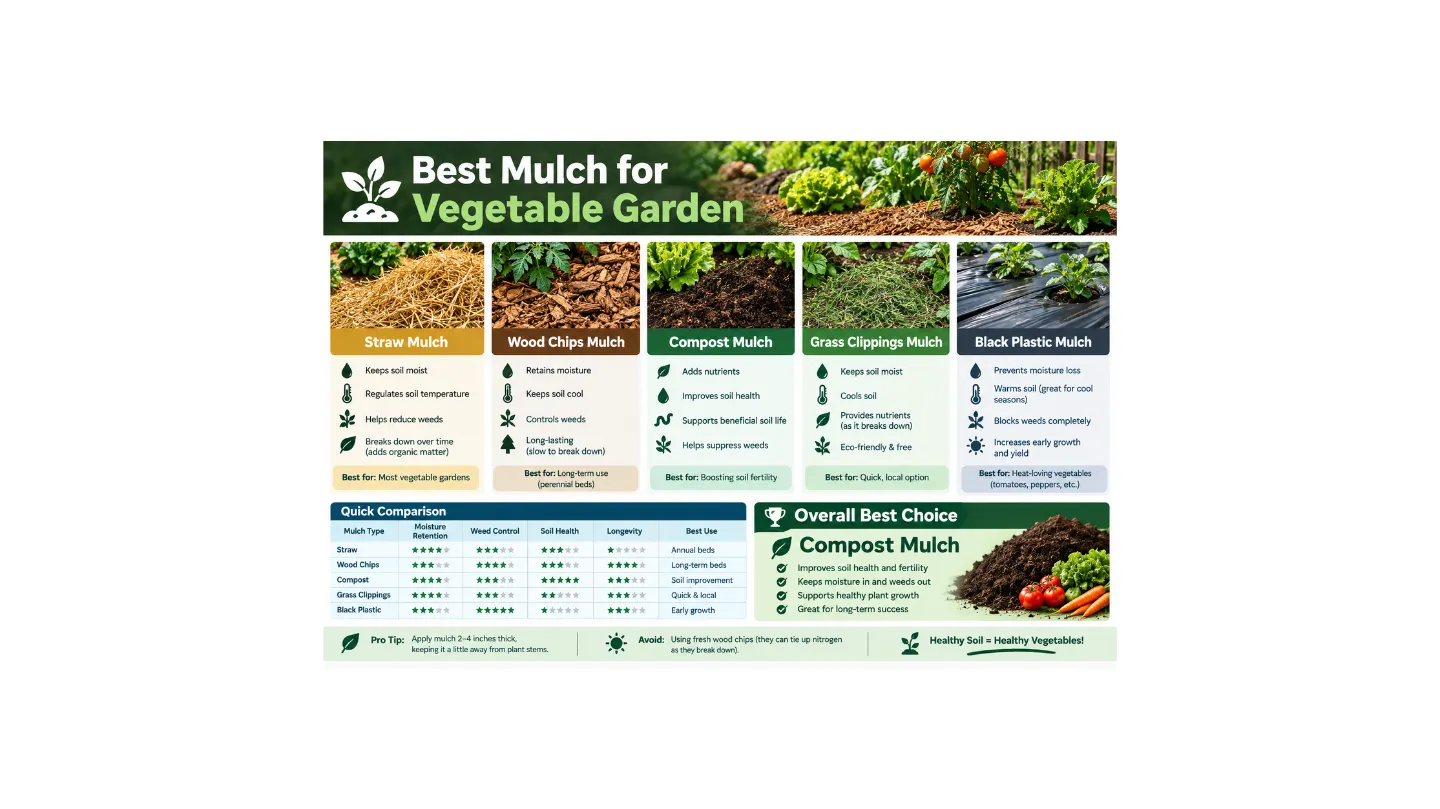
Quick answer: Straw is widely considered the best overall mulch for a vegetable garden. It holds moisture, blocks weeds, keeps fruit clean, and breaks down without stealing nitrogen from your plants. Just make sure it’s weed-free and herbicide-free. Shredded leaves are the best free option, compost is best for feeding the soil, and dry grass clippings are great for leafy greens. Save wood chips for paths and perennial beds. Spread organic mulch 2 to 3 inches deep, and keep it a couple of inches away from plant stems.
Why Mulch Your Vegetable Garden?
Before we look at the best mulch for vegetable garden beds, it helps to know what mulch does. Mulch is any material you spread on top of the soil around your plants. Almost any natural mulch is better than bare soil. Here’s what a good mulch does for vegetables:
- Saves water. Mulch shades the soil and slows evaporation, so you water less often.
- Blocks weeds. A thick layer keeps light from reaching weed seeds, so fewer sprout.
- Keeps soil temperature steady. It keeps roots cooler in summer heat and softens big temperature swings.
- Keeps fruit and leaves clean. Tomatoes, squash, melons, and lettuce stay off the dirt.
- Helps prevent disease. Mulch stops rain from splashing soil, and the disease spores in it, onto lower leaves. This is a big deal for tomatoes.
- Feeds the soil. Organic mulches break down over time, adding organic matter and feeding earthworms and soil life.
- Stops erosion and crusting. Heavy rain won’t wash away or pack down your topsoil.
Best Mulch for Vegetable Garden Beds: Our Top 10 Picks at a Glance
Here’s a side-by-side look at the top choices. Read on for details on each one.
| Mulch | Best for | Adds nutrients? | Lasts | Cost |
|---|---|---|---|---|
| Straw | Best overall; tomatoes, potatoes, squash | A little | One season | Low |
| Shredded leaves | Best free mulch; all beds | Yes | One season | Free |
| Compost | Feeding soil; heavy feeders; new beds | Yes, a lot | A few months | Free to medium |
| Grass clippings | Leafy greens; quick nitrogen | Yes (nitrogen) | Weeks | Free |
| Pine needles (pine straw) | Strawberries, garlic, paths | A little | 1 to 2 seasons | Low to medium |
| Aged wood chips | Paths, perennials (asparagus, rhubarb, berries) | Slowly | 2 to 3 years | Free to low |
| Shredded bark / pine fines | Perennial beds; long-season crops | Slowly | 1 to 2 years | Medium |
| Cardboard or newspaper | Smothering weeds under other mulch | A little | One season | Free |
| Coco coir / coconut husk | Raised beds; containers | No | 1 to 2 years | Medium to high |
| Plastic or paper mulch film | Heat lovers like melons, peppers | No | One season (paper); longer (plastic) | Low to medium |
The 10 Best Mulches for Vegetable Gardens, Compared
1. Straw: Best Overall
Ask experienced gardeners about the best mulch for vegetable garden beds, and straw is the answer you’ll hear most. Straw is the dry, hollow stems left after grain like wheat, oats, or rice is harvested. It’s light, easy to spread, and lets air and water pass through.
Pros:
- Holds moisture and keeps soil cool
- Very good at blocking weeds when spread thick
- Breaks down slowly over the season without tying up nitrogen
- Keeps tomatoes, squash, melons, and strawberries clean
- Low cost, and one bale covers a lot of ground
- Light color reflects heat, which helps in hot summers
Cons:
- Can carry grain seeds that sprout in your beds
- Some straw contains long-lasting weed killer residue (see the warning below)
- Can hide slugs and voles in damp areas
- Keeps soil cooler, so wait to use it on heat lovers until the soil warms
Best for: tomatoes, peppers, potatoes (it helps prevent green, sunburned potatoes), squash, melons, cucumbers, strawberries, and cool-weather crops like lettuce, broccoli, and peas.
Buying tip: Look for straw that’s golden, dry, and smells sweet. Skip straw that’s gray, moldy, or full of seed heads. Ask the seller if it’s weed-free and if the field was sprayed with weed killers.
Straw vs. hay: They are not the same. Hay is whole grass or alfalfa cut for animal feed, so it’s full of seeds that can sprout into weeds. Hay does add more nutrients, and some gardeners like old, spoiled hay. But for most home gardens, straw is the safer choice.
Herbicide warning: Some weed killers used on hay fields, grain fields, and lawns (such as aminopyralid and clopyralid) can stay active in straw, hay, grass clippings, and even manure for a year or more. They can curl, twist, and stunt tomatoes, peppers, beans, peas, potatoes, and other vegetables. Buy from a supplier who can tell you the material is herbicide-free. If you’re unsure, do a quick test: plant a few bean or pea seeds in a pot with some of the mulch mixed in. If the seedlings come up twisted or cupped after a few weeks, don’t use it.
2. Shredded Leaves: Best Free Mulch
If you want the best mulch for vegetable garden beds on a tight budget, start here. Fall leaves are free, easy to find, and full of minerals that trees pull up from deep in the soil. When they break down, they turn into “leaf mold,” a dark, crumbly material that makes soil soft and helps it hold water.
Pros: Free, adds nutrients and organic matter, improves both clay and sandy soil, and feeds earthworms.
Cons: Whole leaves mat down into a soggy layer that blocks water and air. Dry, unshredded leaves blow away. Some gardeners worry about oak leaves being acidic, but research shows shredded oak leaves have very little effect on soil pH once they break down.
How to use: Always shred leaves first. Run over them with a lawn mower a few times, or use a leaf shredder. Save bags of shredded leaves in fall to use in spring and summer.
Best for: all vegetable beds, especially fall and winter crops, and as a winter blanket for empty beds.
3. Compost: Best for Feeding the Soil
Compost may be the best mulch for vegetable garden soil that needs feeding, because it is mulch and fertilizer in one. A thin layer on top of the soil feeds your plants every time it rains. Many longtime gardeners leave about ¾ inch to 1 inch of compost on top of their beds as a mulch and see very few weeds.
Pros: Adds lots of nutrients, holds water, and feeds soil life.
Cons: Breaks down fast, so it needs refreshing. Weeds can sprout in it if it wasn’t composted hot enough. It can get expensive if you buy a lot. Because it’s so rich, weed seeds that blow in may grow happily on top.
Tip: For the best of both worlds, spread an inch of compost, then top it with straw or shredded leaves. The compost feeds the soil, and the top layer blocks weeds and holds moisture.
About mushroom compost: Spent mushroom compost is a good soil builder, but it can be salty. Use it in moderation, mix it into the soil, or let it age before using it around salt-sensitive crops like beans and seedlings.
Best for: heavy feeders like tomatoes, squash, corn, and cabbage, plus new beds and sandy soil.
4. Grass Clippings: Best for Leafy Greens
Grass clippings are free and high in nitrogen, so they give leafy crops like lettuce, kale, chard, and spinach a gentle boost as they break down.
Pros: Free, adds nitrogen, breaks down fast, and blocks weeds well.
Cons: Thick, wet clippings turn into a slimy, smelly mat that can mold and block water. They break down in a few weeks, so you need to add more often.
How to use: Let clippings dry for a day or two first. Spread them in thin layers, about 1 to 2 inches at a time, and add more as they shrink. Never use clippings from a lawn treated with weed killer or “weed and feed” products. Use clippings without seed heads, so you don’t plant grass in your garden.
Best for: leafy greens, between rows, and topping up other mulches.
5. Pine Needles (Pine Straw)
Pine needles are light, airy, and don’t wash away or mat down. They let water through easily and last longer than straw.
Pros: Long-lasting, stay in place on slopes, look tidy, and are free if you have pine trees.
Cons: Can be pricey to buy. Fresh needles are a bit acidic, but a mulch layer has only a small effect on soil pH.
Best for: strawberries (it’s a traditional choice), garlic, onions, blueberries, potatoes, and garden paths.
6. Aged Wood Chips (Arborist Chips)
Arborist wood chips are the mix of chipped branches, bark, and leaves that tree crews produce. Many tree services will drop off a load for free. Wood chips are made popular by “Back to Eden” style gardening, where gardeners cover beds with a thick layer of chips over compost.
Pros: Excellent weed control, holds moisture, lasts 2 to 3 years, slowly builds rich soil, and is often free.
Cons: Where wood chips touch the soil, microbes use nitrogen to break them down. This can briefly “tie up” nitrogen at the soil surface. Chips are also hard to work around when you plant new seeds and seedlings often.
How to use: Use well-aged chips. Keep them on top of the soil. Never dig or till them in. Many gardeners spread compost or aged manure first, then put chips on top. Avoid chips from black walnut trees, which contain a chemical that can harm tomatoes and other vegetables.
Best for: garden paths, and around long-term crops like asparagus, rhubarb, berry bushes, and fruit trees. Most gardeners don’t use them in annual vegetable beds that get replanted often.
7. Shredded Bark and Aged Pine Fines
Shredded hardwood bark and pine bark are common bagged mulches. Some horticulturists like aged pine fines, a finely ground, composted pine bark, for vegetables. It’s fine enough for plants to grow through, holds moisture, rarely draws pests, and slowly breaks down into loose, rich soil.
Pros: Looks neat, lasts longer than straw, and good for weed control.
Cons: Coarse bark is hard to plant through and too chunky for seeding. Like wood chips, it can tie up some nitrogen where it touches the soil. Make sure it’s natural, not dyed.
Best for: perennial vegetable and herb beds, raised bed edges, and long-season crops you plant once.
8. Cardboard and Newspaper: Best for Weed Control
If weeds are your biggest problem, cardboard or newspaper is hard to beat. Lay it down, wet it, and cover it with another mulch. It blocks light so weeds below can’t grow, then breaks down into the soil.
Pros: Free, smothers tough weeds and grass, and worms love it.
Cons: Looks messy on its own and can blow away. Water can run off dry cardboard, so soak it well.
How to use: Use plain brown cardboard with tape and labels removed, or 5 to 10 sheets of black-and-white newspaper. Skip glossy, shiny paper. Overlap the edges by several inches so weeds can’t sneak through, wet it down, and top it with 2 to 3 inches of straw, leaves, or compost.
Best for: new beds, paths, and areas with heavy weeds.
9. Coco Coir and Coconut Husk Mulch
Coconut mulch is made from the husks of coconuts. It’s a renewable byproduct that holds a lot of water and breaks down slowly.
Pros: Holds moisture very well, looks neat, and lasts a long time.
Cons: More expensive and usually shipped long distances. Some products can be salty, so look for “washed” or “low-salt” coir. Adds few nutrients.
Best for: raised beds, containers, and small gardens in dry climates.
10. Plastic and Paper Mulch Film
Large farms often grow vegetables through sheets of plastic. Black plastic warms the soil, blocks weeds, and is useful in short growing seasons. Some gardeners use red plastic for tomatoes and silver reflective plastic to help keep aphids and thrips away. Brown paper mulch and biodegradable films are newer options that break down after the season.
Pros: Warms soil several degrees for an earlier start, blocks nearly all weeds, and keeps fruit clean.
Cons: Blocks rain, so you need drip irrigation or soaker hoses underneath. Plastic adds nothing to the soil, must be removed and thrown away, and can break into small pieces over time. It can overheat soil in hot climates.
Best for: melons, peppers, eggplant, and sweet potatoes in cool or short-season areas.
Mulches to Avoid in Vegetable Gardens
Not every mulch belongs around food. When choosing the best mulch for vegetable garden beds, skip these:
- Dyed or colored wood mulch. The red, black, and brown dyes are mostly considered low risk, but some colored mulch is made from recycled wood that may include treated or painted lumber. It adds no benefit for vegetables, so there’s no reason to take the chance.
- Rubber mulch. Made from old tires, it never breaks down, adds nothing to the soil, and may release chemicals. Keep it out of edible gardens.
- Treated or painted wood. Never use chips from old decks, fences, pallets with chemical treatment, or painted lumber.
- Black walnut chips or leaves. They contain juglone, which harms tomatoes, peppers, potatoes, and other plants.
- Fresh sawdust. It packs down, sheds water, and ties up lots of nitrogen. Use it only on paths, or compost it first.
- Grass clippings from treated lawns, or hay and straw that may contain long-lasting weed killers.
- Landscape fabric in annual beds. It makes planting hard, roots grow into it, and weeds still grow on top of it over time. It’s better for paths.
- Rocks and gravel. They heat up the soil, are hard to remove, and don’t feed the soil.
Is Cedar Mulch Safe for Vegetable Gardens?
Cedar mulch is safe and won’t poison your plants, and it lasts a long time and resists rot. But like other wood mulches, it can tie up nitrogen at the soil surface and isn’t easy to plant through. It’s best for paths and perennial beds rather than annual vegetable rows.
Best Mulch for Vegetable Garden Crops: Match Mulch to What You Grow
| Crop | Best mulch | Tip |
|---|---|---|
| Tomatoes | Straw, shredded leaves, or compost topped with straw | Mulch after soil warms; helps prevent soil-splash diseases |
| Peppers and eggplant | Straw, or black plastic in cool areas | Wait until the soil is warm |
| Potatoes | Straw | Pile it around stems to keep tubers covered and stop greening |
| Squash, cucumbers, melons | Straw or plastic | Keeps fruit clean and dry |
| Lettuce, spinach, kale, chard | Dry grass clippings or shredded leaves | Keeps leaves clean and soil cool |
| Carrots, beets, radishes | Thin layer of fine compost or grass clippings | Mulch only after seedlings are a few inches tall |
| Garlic and onions | Straw or shredded leaves | Mulch garlic in fall for winter protection |
| Strawberries | Straw or pine needles | Keeps berries off the soil |
| Asparagus, rhubarb, berries | Aged wood chips or bark | Long-lasting mulch suits long-lived plants |
What Kind of Mulch Should I Put Around My Tomatoes?
Straw is the top pick for tomatoes. Shredded leaves, dry grass clippings, or compost topped with straw also work well. Spread 2 to 3 inches after the soil has warmed in late spring, and keep it a couple of inches from the stem. The biggest benefit is that mulch stops rain from splashing soil onto lower leaves, which helps prevent common tomato diseases like early blight and septoria leaf spot. It also keeps soil moisture even, which helps prevent blossom-end rot and cracked fruit.
Best Mulch for Vegetable Garden Weeds, Winter, and Raised Beds
Best Mulch to Prevent Weeds
The best mulch for vegetable garden weeds is really a combination. For the strongest weed control, use a two-layer system: cardboard or newspaper on the bottom, then 3 to 4 inches of straw, shredded leaves, or wood chips on top. Pull existing weeds first. Mulch blocks new weed seeds, but it won’t stop tough weeds that are already rooted.
Best Mulch for Vegetable Garden Beds Over Winter
Don’t leave beds bare over winter. Cover empty beds with 3 to 6 inches of shredded leaves, straw, or compost to protect the soil from erosion, feed soil life, and get a head start on spring. For garlic, carrots, and other crops left in the ground, a thick straw or leaf layer helps protect them from freezing and thawing. Pull the mulch back in spring so the soil can warm up. Growing a cover crop, like clover or winter rye, is another great “living mulch” for winter.
Best Mulch for Raised Beds
Raised beds dry out faster than in-ground gardens, so mulch helps a lot. The best mulch for vegetable garden raised beds is usually something fine and easy to plant through. Straw, shredded leaves, compost, and coco coir all work well. Fine-textured mulches are easier to work with in small spaces.
Best Mulch for Garden Paths
Wood chips, bark, and cedar mulch are great for paths. They last for years and block weeds. Put cardboard down first for even better weed control.
How to Mulch a Vegetable Garden the Right Way
Even the best mulch for vegetable garden beds won’t help much if you spread it wrong. Follow these steps.
- Wait for the soil to warm. Mulch keeps soil cool. For heat lovers like tomatoes, peppers, and squash, wait until late spring when the soil is warm, often around 65 to 70°F. For cool-season crops, you can mulch earlier.
- Weed and water first. Pull weeds, then water deeply. Mulch holds in the moisture that’s already there.
- Let seedlings grow first. Wait until seedlings are a few inches tall before mulching around them, so they don’t get buried.
- Spread the right depth. Use 2 to 3 inches for most organic mulches, 3 to 4 inches for straw (it settles), and 1 to 2 inches for grass clippings.
- Keep mulch away from stems. Leave a 1- to 2-inch gap around each plant to prevent rot, disease, and pests.
- Refresh as needed. Organic mulch breaks down, so add more once or twice a season. At the end of the season, you can turn straw, leaves, and compost into the soil or leave them on top.
What Is the 3-3-3 Rule for Mulch?
The 3-3-3 rule is a simple mulching guide often used for trees and shrubs: spread mulch about 3 inches deep, keep it 3 inches away from the trunk or stem, and cover a circle about 3 feet wide around the plant. For vegetables, the depth and gap are a good guide, but you’ll usually mulch the whole bed instead of a circle.
Which Plants Don’t Like Mulch?
- Tiny seeds and young seedlings, like carrots, lettuce, and radishes, which can get smothered. Mulch after they’re a few inches tall.
- Heat lovers in cool spring soil, like tomatoes, peppers, melons, and okra. Mulching too early keeps soil cold and slows growth.
- Plants in soggy, poorly drained soil, where mulch can keep soil too wet and cause rot.
- Gardens with heavy slug or snail problems, where thick, damp mulch gives them a place to hide. Use a thinner layer and pull it back from leaves.
- Self-seeding crops, like dill and cilantro, if you want them to come back on their own.
What About a “Dust Mulch”?
Some old-time gardeners say the best mulch for vegetable garden rows costs nothing at all: a “dust mulch.” It’s a thin, loose, dry layer of surface soil made by lightly hoeing the top inch or two. It breaks the tiny channels that pull water up to the surface, so it slows evaporation and kills young weeds. Gardening books from over 100 years ago recommended it. It’s free and needs no hauling. The downside is that you must keep hoeing, especially after every rain, and it doesn’t feed the soil or protect it from heavy rain like organic mulch does. It can work in dry climates, but most gardeners today prefer organic mulch.
How Much Mulch Do You Need?
Formula: square feet × depth in inches ÷ 12 = cubic feet of mulch.
| Mulch amount | Covers at 2 inches deep | Covers at 3 inches deep |
|---|---|---|
| One 2-cubic-foot bag | About 12 sq ft | About 8 sq ft |
| One 3-cubic-foot bag | About 18 sq ft | About 12 sq ft |
| One cubic yard (27 cubic feet) | About 160 sq ft | About 108 sq ft |
A standard straw bale usually covers about 50 to 100 square feet, depending on how thick you spread it. A 4-by-8-foot raised bed (32 square feet) needs about 8 cubic feet of mulch at 3 inches deep.
Cost of the Best Mulch for Vegetable Garden Use
| Mulch | Typical cost |
|---|---|
| Shredded leaves, grass clippings, cardboard | Free |
| Arborist wood chips | Often free from tree services |
| Straw | About $8 to $20 per bale; bagged straw costs more per foot |
| Bagged bark or hardwood mulch | About $4 to $8 per 2-cubic-foot bag |
| Bagged pine needles | About $15 to $20 per bag |
| Compost | Free if homemade; about $30 to $60 per cubic yard in bulk |
| Coco coir mulch | Higher; varies widely |
Rough price ranges only. Prices vary by region and season.
Common Mulching Mistakes to Avoid
- Piling mulch against plant stems (“volcano mulching”)
- Mulching cold soil too early for heat-loving crops
- Using whole leaves that mat down
- Spreading thick, wet grass clippings
- Using hay full of seeds, or straw and clippings with weed killer residue
- Digging wood chips into the soil
- Spreading mulch too thin (under 2 inches), which won’t stop weeds
- Mulching dry soil without watering first
Frequently Asked Questions
What is the best mulch for vegetable garden beds?
Straw is the best overall choice for most gardens. It holds moisture, blocks weeds, keeps fruit clean, and doesn’t tie up nitrogen. Shredded leaves are the best free option, and compost is best for feeding the soil.
Is it a good idea to put mulch in a vegetable garden?
Yes. Mulch saves water, blocks weeds, keeps soil temperature steady, prevents soil-splash diseases, and feeds the soil as it breaks down. Almost any natural mulch is better than bare soil.
What kind of mulch should I put around my tomatoes?
Straw is the top choice. Shredded leaves, dry grass clippings, or compost topped with straw also work well. Spread 2 to 3 inches after the soil warms, and keep it a couple of inches from the stem.
Is wood mulch good for vegetable gardens?
Aged wood chips are great for paths and perennial crops. In annual beds, they can tie up nitrogen at the soil surface and are hard to plant through. If you use them, keep them on top of the soil and never dig them in.
What is the 3-3-3 rule for mulch?
Spread mulch about 3 inches deep, keep it 3 inches from the stem or trunk, and cover about a 3-foot circle around the plant. It’s mainly a guide for trees and shrubs.
Which plants don’t like mulch?
Tiny seedlings like carrots and lettuce, heat lovers in cold spring soil, plants in soggy soil, and self-seeding herbs. Wait to mulch until seedlings are a few inches tall and the soil is warm.
Should I use hay or straw in my garden?
Straw is usually better. Hay contains seeds that sprout into weeds. Both can carry weed killer residue, so buy from a source that can confirm it’s herbicide-free.
Is colored mulch safe for vegetable gardens?
It’s best to avoid it. Dyed mulch may be made from recycled wood that could include treated lumber, and it offers no benefit for vegetables.
When should I mulch my vegetable garden?
Mulch heat-loving crops in late spring after the soil warms, and cool-season crops earlier. Mulch empty beds in fall to protect the soil over winter.
Final Thoughts
So, what’s the best mulch for vegetable garden beds? For most gardeners, it’s clean, weed-free straw. Shredded leaves are the best free choice, compost feeds the soil best, and dry grass clippings are great for leafy greens. Save wood chips and bark for paths and perennial crops, and skip dyed mulch, rubber, and treated wood.
Whatever you choose, spread it 2 to 3 inches deep, keep it away from stems, and wait for warm soil before mulching heat lovers. Check that your straw, hay, and clippings are free of weed killers. Do this, and you’ll water less, weed less, and enjoy a healthier, cleaner harvest.