Why Do My Lights Flicker? 10 Causes, Fixes and When to Worry
Flickering lights are one of the most common electrical problems in American homes. Sometimes it’s just a loose bulb that takes two seconds to fix. Other times, it’s a warning sign of loose wiring or a problem with your home’s power supply. The tricky part is knowing which one you’re dealing with. If you’ve been asking, “Why do my lights flicker?”, this guide will help you find the answer.
In this guide, we explain the most common causes of lights flickering in house fixtures and rooms, in plain and simple words. You’ll learn how to distinguish a harmless flicker from a dangerous one by examining its pattern. We’ll also cover LED lights flickering, lights that flicker when the AC turns on, and whole-house flickering. Then we’ll show you safe DIY checks, latest repair costs, and when to call an electrician. By the end, you’ll know exactly what’s going on and what to do next.
Quick answer: Lights usually flicker because of a loose or failing bulb, an LED bulb on an old dimmer switch, a worn switch or fixture, or a brief voltage dip when a big appliance like an AC or fridge starts. Those are usually harmless. But flickering in several rooms, flickering that’s getting worse, or flickering with buzzing, burning smells, or warm switches can mean loose wiring, a loose neutral, or a panel or utility problem. Those need an electrician or your power company.
Safety first: If flickering comes with a burning smell, smoke, sparks, crackling or popping sounds, or a hot switch or outlet, turn off that circuit at the breaker and call a licensed electrician right away. If lights across the whole house are flickering and some get brighter while others get dimmer, call your utility company or an electrician immediately.
Step 1: Read the Flicker Pattern
The fastest way to answer “why do my lights flicker?” is to notice where and when it happens. The pattern points straight to the cause.
| Pattern | Most likely cause | How serious? |
|---|---|---|
| One bulb or one fixture | Loose or failing bulb, bad socket, wrong bulb type | Usually low |
| Only when dimmed | LED bulb on an incompatible dimmer | Low |
| When you touch or flip the switch | Worn or loose switch | Medium |
| One room only | Loose connection on that circuit, overloaded circuit | Medium |
| Brief dim when AC, fridge, or washer starts | Normal startup surge | Usually low |
| Big or long dim when appliances start | Overloaded circuit, weak AC capacitor, wiring issue | Medium to high |
| Whole house, random | Loose neutral, panel problem, utility issue | High |
| Some lights brighten while others dim | Loose or failing neutral | High; act now |
| Neighbors’ lights flicker too | Utility or transformer problem | Call the power company |
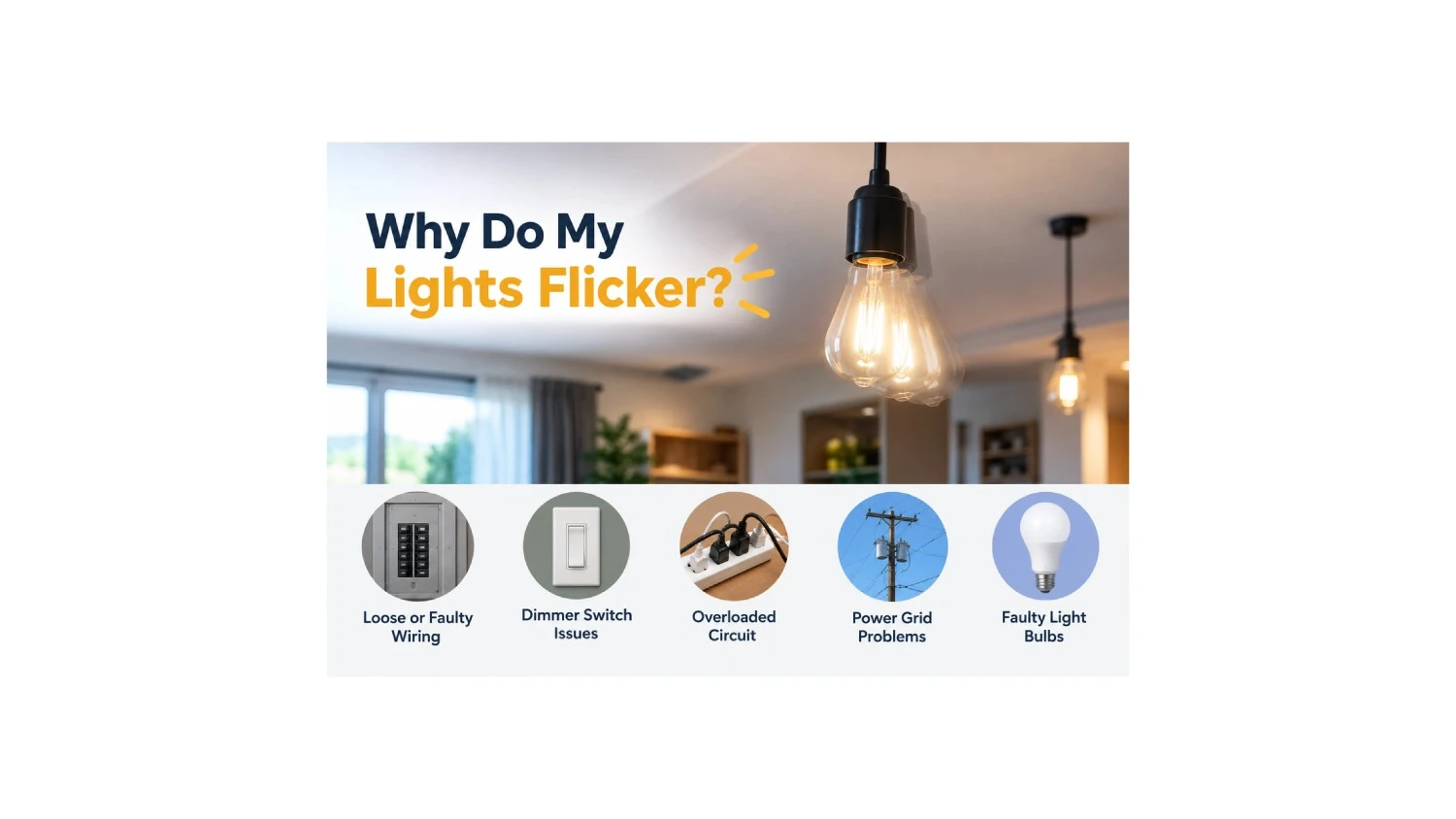
Why Do My Lights Flicker? 10 Common Causes
Here are the most common answers to “why do my lights flicker?”, starting with the simplest.
1. Loose Bulb
If you’re asking “why do my lights flicker?” about a single lamp or fixture, start here. A bulb that isn’t screwed in all the way can lose contact with the socket for a split second, causing a flicker. This is the most common cause, and the easiest to fix.
Fix: Turn off the light, let the bulb cool, and gently tighten it. Don’t overtighten.
2. Old, Failing, or Cheap Bulb
Bulbs often flicker near the end of their life. Cheap LED bulbs can also flicker because of poor-quality internal parts called drivers. Fluorescent and CFL bulbs may flicker when they’re cold or warming up.
Fix: Swap in a new, good-quality bulb from a trusted brand. If the new bulb works, you’ve found the problem.
3. LED Bulbs on an Incompatible Dimmer
This is one of the top reasons for LED lights flickering. Many older dimmer switches were made for old-style incandescent bulbs. LEDs use much less power and work differently, so an old dimmer can’t control them smoothly. The result: flickering, strobing, or buzzing, especially at low brightness.
Fix:
- Make sure the bulbs say “dimmable” on the box.
- Replace the old dimmer with an LED-rated dimmer (often called a “CL,” “ELV,” or “trailing-edge” dimmer).
- Check the dimmer maker’s compatibility list for your bulbs.
- If you only have one or two LEDs on a dimmer, the load may be too small. Some dimmers have a “low-end trim” adjustment to fix this.
4. Worn or Loose Light Switch
Switches wear out over time. A loose connection inside the switch can interrupt power and cause flickering. If the light flickers when you touch, wiggle, or flip the switch, the switch is likely the problem.
Fix: Replacing a switch is a simple job for an electrician. If you’re experienced with electrical work, turn off the breaker first and test that power is off before touching any wires.
5. Faulty Fixture or Socket
Inside the fixture, the small metal tab in the socket can get flattened or corroded, so the bulb doesn’t make good contact. Fixture wires can also loosen or wear out, especially in old or overheated fixtures.
Fix: With the power off at the breaker, you can gently bend the socket tab up a tiny bit. If the fixture is old, scorched, or still flickers, replace it or have an electrician check it.
6. Big Appliances Starting Up
Air conditioners, refrigerators, washers, dryers, sump pumps, and space heaters pull a big burst of power when they start. That can cause a brief voltage dip and a quick flicker or dim in your lights. This is why so many people search “lights flicker when AC turns on” or “why do my lights flicker when appliances start?”
A quick dim of about a second is usually normal. But HVAC experts note that lights losing 30% to 40% of their brightness can point to a weak AC capacitor, and dimming with buzzing or crackling can point to an overloaded circuit.
Fix: If dimming is strong or long, have an HVAC tech check the AC’s capacitor or add a “hard start kit,” and have an electrician check whether big appliances need their own dedicated circuits.
7. Overloaded Circuit
When too many devices run on one circuit, the circuit struggles to keep up, and lights may flicker or dim. A space heater, hair dryer, or microwave on the same circuit as your lights is a common cause.
Fix: Move high-power devices to other circuits. If it keeps happening, an electrician can add circuits. If your breaker is also tripping, see our guide on why a circuit breaker keeps tripping.
8. Loose or Damaged Wiring
Wires can loosen at outlets, switches, junction boxes, and fixtures over time because of heat, age, poor workmanship, or even rodents. Loose connections can “arc,” or spark, which creates heat and is a fire risk. The NFPA has reported that electrical distribution and lighting equipment were involved in more than 36,000 home fires a year from 2015 to 2019.
Signs: Flickering in one room or on one circuit, warm or discolored outlets or switch plates, buzzing, crackling, or a burning smell.
Fix: Turn off the breaker for that area and call a licensed electrician. Don’t ignore this one.
9. Loose Neutral or Panel Problem
If you’re wondering “why do my lights flicker all over the house?”, this is the cause to worry about most. When lights flicker across the whole house, especially on several different circuits, the problem is often at the main panel or the service wires coming into your home. A loose neutral connection is one of the most common causes. Electricians often say the same thing: random flickering throughout the whole house is usually a loose neutral, sometimes on the utility’s side.
Signs of a loose neutral:
- Lights in some rooms get brighter while others get dimmer
- Flickering that changes when big appliances turn on
- Electronics acting strangely, resetting, or failing
- Light bulbs burning out often
- Flickering that gets worse in humid or rainy weather
- A faint crackling or buzzing sound from the panel or meter
Fix: Call your utility company and a licensed electrician right away. A loose neutral can send too much voltage to some outlets and damage electronics or start a fire. Normal household voltage in the U.S. is about 114 to 126 volts. An electrician can test each side of your panel to find the problem.
10. Utility or Neighborhood Problems
Sometimes the problem is outside your home. Heavy demand in your area, a failing transformer, storms, tree branches touching lines, or damaged service wires can cause flickering. If your neighbors see it too, it’s likely a utility issue.
Fix: Report it to your power company. Utilities are usually responsible for the wires up to your meter.
LED Lights Flickering: Special Causes
LED lights flickering is so common that it deserves its own section. Besides old dimmers, here’s what else can cause it:
- Cheap drivers: Every LED bulb has a tiny power supply inside. Low-quality ones flicker, especially as they heat up.
- Heat: LEDs in enclosed fixtures can overheat and flicker. Use bulbs rated for enclosed fixtures.
- Mixing bulb types: Mixing LEDs with other bulbs, or different LED brands, on the same dimmer can cause uneven flicker.
- Smart switches and “ghosting”: Some smart switches and lighted switches let a tiny current pass even when off, making LEDs glow or flicker faintly. A neutral wire, a different switch, or a bypass device can fix it.
- LED strip lights: Long runs can lose voltage and flicker at the far end. A bigger power supply or a second power feed helps.
- Dimmer wattage limits: Old dimmers were often rated for 600 watts of incandescent bulbs. LED-rated dimmers usually have a lower maximum for LEDs and sometimes a minimum load. Too few or too many LEDs on one dimmer can cause flicker.
Why Do LED Lights Flicker When Old Bulbs Didn’t?
Old incandescent bulbs have a hot metal filament that keeps glowing for a split second when voltage dips, so small power changes were hard to see. LEDs react almost instantly. Each LED bulb has a small power supply inside that converts household AC power to DC. When voltage drops, even briefly, that power supply can drop out and the light flickers. That’s why LED lights flickering is often the first sign of a voltage problem that was always there. If all your LEDs flicker together across the house, treat it as a supply problem, not a bulb problem.
Why Are My Lights Flickering in Other Situations?
Lights flickering in house fixtures can look different depending on when and where it happens. Here’s what each situation usually means.
Why Do My Lights Flicker in One Room?
If only one room flickers, the problem is usually on that room’s circuit: a loose connection at an outlet, switch, or fixture, an old dimmer, or an overloaded circuit. Check bulbs and dimmers first, then call an electrician if it continues.
Why Do My Lights Flicker All of a Sudden?
Sudden flickering can come from a storm or utility problem, a new appliance overloading a circuit, or a connection that just came loose. If it starts suddenly in many rooms, call your utility and an electrician.
Why Do My Lights Flicker Every Night at the Same Time?
Flicker at the same time each night often lines up with something on a schedule, like your AC, heat pump, an electric water heater on a timer, a pool pump, or an EV charger turning on. As electrical engineers point out, it doesn’t have to be your equipment. A neighbor’s big load switching on can cause a dip on a shared transformer too. If it’s a brief dip when an appliance starts, it’s usually normal. If it’s strong or getting worse, have it checked.
Why Do Multiple Lights Flicker in My House?
Multiple lights flickering in house fixtures across different rooms usually points to a bigger problem, like a loose neutral, a panel issue, or trouble with the utility’s service lines. This needs a professional.
Can a Circuit Breaker Cause Lights to Flicker?
Yes. A worn breaker or a loose connection where the wire attaches to the breaker can cause flickering on that circuit. You may also notice the breaker feels warm. An electrician should check and replace it.
Why Do My Lights Flicker When the Washing Machine or Refrigerator Turns On?
Washers, dryers, refrigerators, and freezers all have motors. Motors pull a big rush of current when they start, which briefly lowers the voltage. A quick dim each time the motor starts is usually normal, especially in older homes with smaller wiring. But if the lights keep flickering the whole time the appliance runs, check the plug and outlet, and have an electrician check the circuit connections. A dedicated circuit for the appliance often solves it.
Why Do My Lights Flicker When It’s Windy or After a Storm?
Wind can make power lines swing and touch each other or tree branches. The utility’s equipment briefly cuts power and turns it back on in a split second, which you see as a quick flicker. This is a utility issue. If it happens often, or a tree branch is touching the line to your house, call your power company. Never trim branches near power lines yourself.
Why Do My Lights Flicker When the Tankless Water Heater Comes On?
Electric tankless water heaters use a very large amount of power, often far more than any other appliance in the house. When one turns on, it can cause a noticeable voltage dip, especially if your service or panel is undersized. An electrician should check that the heater has the right wire size, breaker, and service capacity.
Why Do My Lights Flicker on a Generator or Inverter?
Many cheaper inverters and generators produce “modified sine wave” power, which is choppy compared with the smooth power from the grid. LED bulbs and their drivers often flicker or buzz on this kind of power. Generators can also sag in voltage when big loads start. A “pure sine wave” inverter or an inverter generator usually fixes it.
Why Do My Car Lights Flicker?
Car lights are a different system. Flickering usually comes from a weak battery, a failing alternator, a loose battery cable, or a bad ground connection. Have a mechanic test the battery and charging system.
Is There a Spiritual Meaning to Lights Flickering?
Some people link flickering lights to spiritual signs or superstitions. Whatever you believe, always rule out electrical causes first. Flickering can be a real safety warning, so it’s worth checking your bulbs, switches, and wiring.
Are Flickering Lights a Fire Hazard?
Sometimes. If you’re asking “why are my lights flickering, and is it dangerous?”, the answer depends on the cause. A loose bulb or a cheap LED on an old dimmer isn’t dangerous. But flickering caused by loose wiring, arcing, a loose neutral, or an overloaded circuit can lead to overheating and fires. Should you be concerned if your lights flicker? Take it seriously if:
- It happens in more than one room.
- It’s getting more frequent or worse.
- You smell burning or hear buzzing or crackling.
- Switches, outlets, or cover plates feel warm or look discolored.
- Your breaker trips often.
- Your home is older, with aluminum or knob-and-tube wiring, or a panel that’s 30+ years old.
How to Stop Your Lights From Flickering: Safe DIY Checks
Once you know why your lights flicker, fixing it is often simple. Here’s how to stop lights from flickering, starting with the safest steps:
- Tighten the bulb (with the light off and cool).
- Swap in a new, good-quality bulb.
- Check that the bulb is right for the fixture: dimmable if on a dimmer, rated for enclosed fixtures if covered, and the right wattage.
- Test without the dimmer. Turn the dimmer to full brightness. If flicker stops, the dimmer is likely the issue.
- Wiggle the switch gently. If the light flickers, the switch needs replacing.
- Note the pattern. One light, one room, the whole house, or only when appliances start?
- Ask your neighbors. If their lights flicker too, call the power company.
- Stop and call a pro for anything inside walls, the panel, or the service connection.
When to Call an Electrician
If you still can’t answer “why do my lights flicker?” after the checks above, or you notice any of these signs, call a licensed electrician:
- Flickering continues after you’ve changed the bulb and checked the dimmer.
- Lights flicker in more than one room or across the whole house.
- Some lights get brighter while others dim.
- You smell burning, see sparks, or hear buzzing or crackling.
- Switches or outlets feel warm or look scorched.
- Lights dim a lot when big appliances start, or your lights flicker when AC turns on for more than a second.
- Your breaker keeps tripping.
How Much Does It Cost to Fix Flickering Lights?
The cost depends on the answer to “why do my lights flicker?” A bulb costs a few dollars, while wiring or panel work costs much more.
| Fix | Typical cost |
|---|---|
| New LED bulb | A few dollars |
| LED-compatible dimmer (DIY part) | About $20 to $60 |
| Electrician service call and diagnosis | About $120 to $250 |
| Troubleshooting a hidden problem | About $380 to $800 |
| Outlet, switch, or wiring repair | About $250 to $900 |
| Panel repair or upgrade | About $4,000 to $12,000+ |
| Utility-side loose neutral or service wire | Often fixed by the utility at no cost to you |
Electrician costs are typical 2026 ranges in higher-cost areas. Prices vary by region. Dimmer price is a general retail estimate.
Frequently Asked Questions
Why do my lights flicker?
The most common causes are a loose or failing bulb, LED bulbs on an incompatible dimmer, a worn switch or fixture, a brief voltage dip when a big appliance starts, an overloaded circuit, loose wiring, a loose neutral, or a utility problem.
Should I be concerned if my lights flicker?
One flickering bulb usually isn’t a concern. Flickering in several rooms, flickering that’s getting worse, or flickering with burning smells, buzzing, or warm switches can be a fire risk and needs an electrician.
How do I stop my lights from flickering?
Tighten or replace the bulb, use good-quality dimmable LEDs, and replace old dimmers with LED-rated ones. If flickering continues or affects multiple rooms, call an electrician.
Why do my lights flicker when the AC turns on?
Your AC draws a big burst of power when it starts, which can cause a brief dip in voltage. A quick dim is normal. Strong or long dimming can mean a weak AC capacitor, an overloaded circuit, or a wiring problem.
Why are my LED lights flickering?
Usually because they’re on a dimmer that isn’t made for LEDs, they’re low-quality bulbs, they’re overheating in an enclosed fixture, or they’re on a smart switch that leaks a small current.
Can a loose neutral cause lights to flicker?
Yes. A loose neutral is a common cause of whole-house flickering, often with some lights getting brighter while others dim. It can damage electronics and start fires, so call your utility and an electrician right away.
Are flickering lights a fire hazard?
They can be. Flickering caused by loose wiring, arcing, or a loose neutral can overheat wires and connections. Flickering caused by a loose bulb or an old dimmer usually isn’t dangerous.
Final Thoughts
So, why do my lights flicker? Most of the time, it’s something simple: a loose bulb, a cheap or failing LED, an old dimmer, or a big appliance starting up. Those are easy to fix and usually harmless. Start with the bulb and dimmer, and pay attention to the pattern.
But if flickering spreads to several rooms, gets worse, or comes with buzzing, burning smells, or warm switches, don’t wait. Turn off the affected circuit and call a licensed electrician, and contact your utility if the whole house is affected. Catching the problem early keeps your home and family safe.