Tankless vs Tank Water Heater: Pros, Cons, Costs and Which to Buy
When your old water heater stops working, you have a big choice to make. You can buy another tank, or you can switch to a tankless model. Both will give you hot water, but they work in very different ways. They also cost different amounts to buy, install, and run. Picking the wrong one can mean cold showers or money wasted for years.
In this guide, we compare the tankless vs tank water heater choice in plain, simple words. You’ll see the real pros and cons of each, with 2026 prices for buying and installing them. We’ll explain how much hot water each one gives you and how long each one lasts. We’ll also answer the big question: is a tankless water heater worth it for your home? By the end, you’ll know which type fits your family, your house, and your budget.
Quick answer: A tank water heater costs less to buy and install (about $600 to $2,500) and works well for big families who use lots of hot water at once. A tankless water heater costs more upfront (about $1,000 to $4,000 or more installed), but it gives you endless hot water, uses less energy, saves space, and lasts about 20 years instead of 8 to 12. Tankless is usually worth it if you plan to stay in your home for many years and already have natural gas.
Tankless vs Tank Water Heater: Quick Comparison
Here’s a side-by-side look at the tankless vs tank water heater choice before we go into the details.
| Feature | Tank water heater | Tankless water heater |
|---|---|---|
| How it works | Stores and keeps 30 to 80 gallons hot all day | Heats water only when you turn on a tap |
| Installed cost (2026) | About $600 to $2,500 | About $1,000 to $4,000+ |
| Hot water supply | Can run out; needs time to reheat | Endless, but limited by flow rate |
| Energy efficiency | Loses heat while sitting (standby loss) | Up to 24% to 34% more efficient |
| Lifespan | About 8 to 12 years | About 15 to 20+ years |
| Size | Large; takes floor space | Small; mounts on a wall |
| Maintenance | Flush once a year; check anode rod | Descale once a year; clean filter |
| Installation | Simple swap in most homes | May need a bigger gas line, new venting, or electrical upgrades |
| Best for | Tight budgets, big families, simple replacements | Long-term owners, small spaces, energy savings |
How Each Type Works
To understand the tankless vs tank water heater difference, start with how each one makes hot water.
Tank Water Heaters
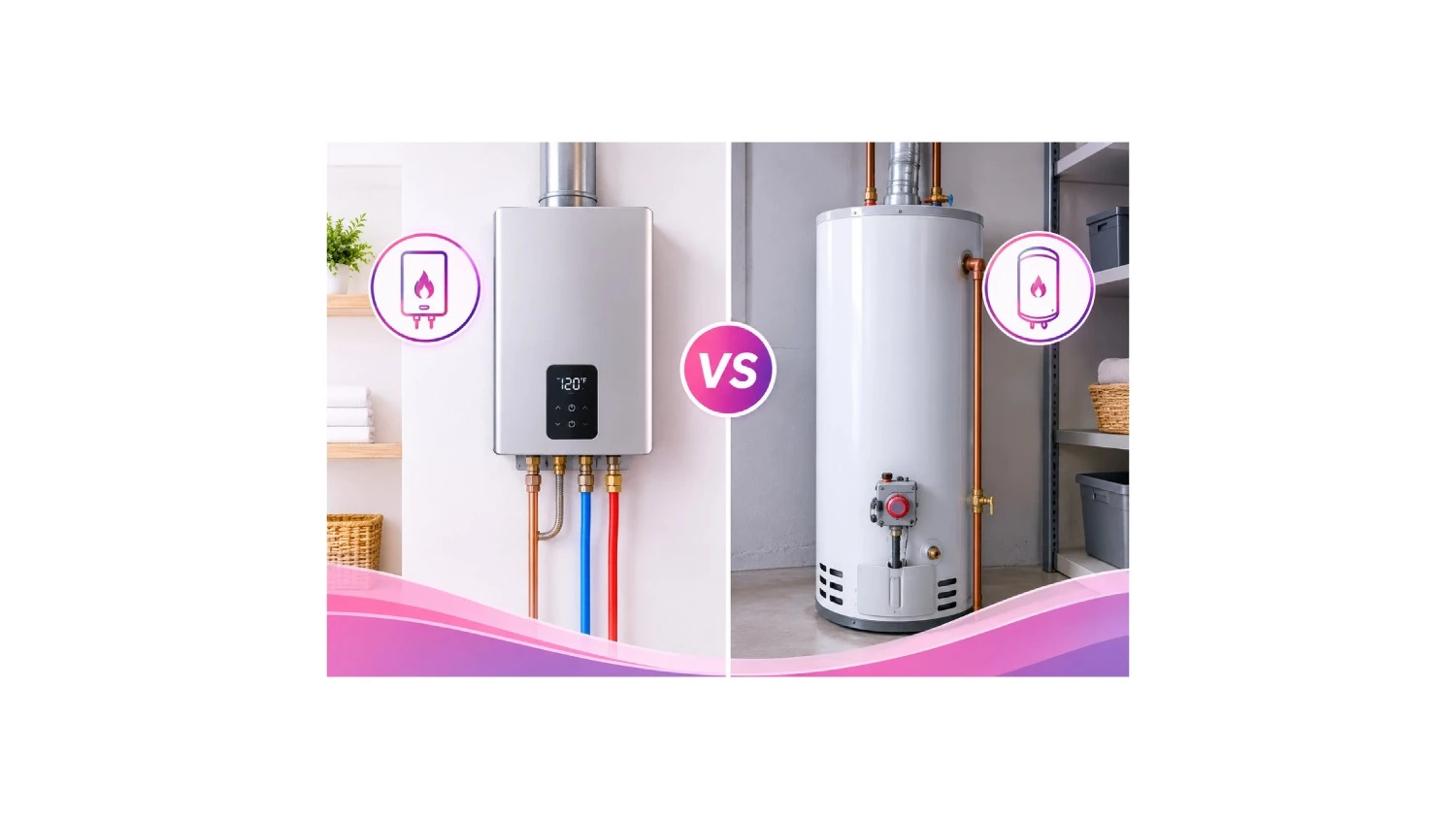
A tank water heater (also called a storage or “traditional” water heater) holds a large tank of water, usually 40 to 50 gallons in most homes. A gas burner or electric elements keep that water hot all day and night. When you turn on a hot tap, hot water flows out of the top, and cold water comes in at the bottom to be heated. If you use up all the hot water, you have to wait for the tank to heat a new batch.
Tankless Water Heaters
A tankless water heater (also called an on-demand water heater) doesn’t store any water. When you turn on a hot tap, cold water flows through the unit, and a powerful gas burner or electric element heats it right away. When you turn off the tap, the heater shuts off. Because it only heats what you use, it doesn’t waste energy keeping a tank warm.
Tankless vs Tank Water Heater Pros and Cons
Here’s an honest look at tankless vs tank water heater pros and cons, so you can see the full picture.
Tank Water Heater Pros
- Lower upfront cost. Tanks are cheaper to buy and install.
- Easy replacement. Swapping an old tank for a new one is usually quick and simple.
- Handles many taps at once. A full tank can supply two showers and a dishwasher at the same time without a drop in temperature, until it runs out.
- Works during a power outage (most gas tank models with a standing pilot light).
- Simple to repair. Most plumbers can fix one quickly, and parts are easy to find.
Tank Water Heater Cons
- Hot water can run out. Long showers or a big family can drain the tank.
- Wastes energy. It keeps water hot even when no one is using it.
- Shorter life. Most last about 8 to 12 years.
- Takes up space. A 50-gallon tank needs a good chunk of floor space.
- Risk of leaks. When an old tank fails, it can leak dozens of gallons of water.
Tankless Water Heater Pros
- Endless hot water. It doesn’t run out, as long as you don’t go over its flow limit.
- Lower energy use. No standby heat loss means lower bills, especially with gas.
- Lasts longer. Many last 15 to 20 years or more with care.
- Saves space. It’s about the size of a suitcase and hangs on a wall.
- Less risk of a big leak, since there’s no tank full of water.
Tankless Water Heater Cons
- Higher upfront cost. The unit and the install both cost more.
- Installation upgrades. You may need a bigger gas line, new venting, or a larger electrical panel.
- Flow limits. Running too many taps at once can make the water lukewarm.
- Short wait and “cold water sandwich.” You may get a short burst of cold water between uses.
- Needs power. Even gas tankless units need electricity, so they won’t work in a power outage.
- Yearly descaling. Hard water can build up inside and must be cleaned out.
Tankless Water Heater Cost vs Tank
Cost is usually the deciding factor in any tankless vs tank water heater decision. Here’s how tankless water heater cost vs tank compares in 2026.
Upfront and Installation Costs
| Type | Installed cost range | Typical average |
|---|---|---|
| Gas tank | $900 to $3,000 | About $1,400 |
| Electric tank | $500 to $3,500 | Usually less than gas |
| Tankless (gas or electric) | $1,000 to $4,000 | Often $2,500 to $4,300 when switching from a tank |
| Heat pump (hybrid) tank | $1,200 to $4,600 | Varies by size |
Typical 2026 installed cost ranges. Some large retailers report average installed totals of about $1,950 for a tank and $4,300 for tankless.
Hidden Costs When Switching to Tankless
This is the part of the tankless vs tank water heater comparison many people miss. Replacing a tank with another tank is simple. Switching from a tank to tankless often isn’t. Watch for these extra costs:
- Bigger gas line and meter check: Gas tankless units need much more gas when they run. A whole-house unit can use around 150,000 to 200,000 BTU per hour, about twice what a typical furnace uses. Add your furnace, stove, dryer, and fireplace, and your gas line or meter may not keep up. Some owners only find out when the unit starts showing low gas pressure errors. Ask your installer to add up every gas appliance and confirm the line and meter are big enough.
- New venting: Gas tankless units need their own special vent pipe. Power venting can add $300 to $1,000.
- Electrical upgrades: Whole-house electric tankless units can need 100 to 140 amps. Many homes need a panel upgrade, which can cost thousands.
- Permits: $25 to $1,500, higher when new gas or electric work is needed.
- Water softener: Recommended in hard-water areas to protect the unit.
Running Costs
Tank water heaters keep water hot all day, so they use more energy. Here’s what a family using 64 gallons of hot water a day might pay each year to run different tank models, based on manufacturer estimates:
- Electric tank: about $668 a year
- Propane tank: about $403 a year
- Standard gas tank: about $315 a year
- High-efficiency gas tank: about $202 a year
- Heat pump (hybrid) electric tank: about $176 a year
A gas tankless unit typically uses less gas than a standard gas tank, because it doesn’t lose heat while sitting. The savings for most families are often around $100 a year compared with a gas tank, depending on your gas prices and how much hot water you use.
When Does Tankless Pay for Itself?
Service plumbers often say that switching from a tank to tankless costs roughly 50% more in total than replacing a tank with a similar tank, once the extra gas, venting, or electrical work is included.
Here’s a simple example. Say a gas tankless unit costs $2,000 more to install than a gas tank, and it saves you about $100 a year on energy. On energy savings alone, it would take many years to pay back. But a tankless unit also lasts about twice as long, so you may avoid buying a second tank. When you count that, most homeowners break even somewhere around 10 years or more. If you’ll move in a few years, a tank is usually the smarter money choice.
Don’t forget water costs. One homeowner with a high-end gas tankless unit found it saved about 30% on gas, but the longer wait for hot water at the taps wasted enough water to cancel out much of the savings. By his math, it would take over 20 years to earn back the higher price. Your results depend on how far your bathrooms are from the heater and on your water rates. Other owners report big gas savings, especially in warmer months, so the numbers really do vary from home to home.
Hot Water Supply: Endless vs Limited
This is where the tankless vs tank water heater debate gets interesting.
A tank gives you a lot of hot water at once, but only until it runs out. A 50-gallon tank can handle two showers and a dishwasher at the same time. But if your family takes five showers in a row, the last person may get a cold one.
A tankless unit never runs out, but it can only heat so much water at once. According to the U.S. Department of Energy, a typical tankless water heater makes about 2 to 5 gallons of hot water per minute (GPM). Gas models make more than electric ones. If you run more hot water than that, the water gets lukewarm.
How Much Hot Water Do You Need at Once?
| Fixture | Typical flow (gallons per minute) |
|---|---|
| Shower | 1.5 to 2.5 |
| Bathroom sink | 0.5 to 1.5 |
| Kitchen sink | 1.5 to 2.0 |
| Dishwasher | 1.0 to 1.5 |
| Washing machine | 1.5 to 2.0 |
| Bathtub | 4.0 or more |
Add up what you might run at the same time. Two showers and a dishwasher could need about 5 to 6 GPM. Keep in mind that many whole-house electric tankless units only deliver about 2 to 3 GPM in real use, which won’t fill a bathtub quickly or run two showers at once.
Sizing also depends on temperature rise: how much the heater must warm the incoming water. If your tap water comes in at 50°F and you want 120°F, that’s a 70°F rise. In cold climates, where incoming water is very cold, a tankless unit has to work harder, so its flow drops. That’s why sizing matters so much. A plumber should size your unit based on your family and your local water temperature.
Does a Tankless Water Heater Give You Instant Hot Water?
No, and this surprises many people. A tankless unit heats water quickly, but the hot water still has to travel through your pipes to reach the tap. The cooled-down water sitting in those pipes comes out first. In fact, the wait can be a bit longer than with a tank, because the burner needs a few seconds to fire up. In a large house, owners report waiting 30 seconds to a minute in rooms far from the heater.
Ways to get hot water faster:
- A recirculation pump keeps hot water moving through the pipes so it’s ready at the tap.
- A tankless model with a small built-in buffer tank reduces the wait and the “cold water sandwich.”
- A small point-of-use heater under a far-away sink or vanity delivers hot water almost instantly to that one spot.
- Place the heater centrally or use more than one unit in very large homes.
How Long Does a Tank Take to Reheat?
If you use up all the hot water in a tank, you have to wait for it to heat a new batch. A typical 40- or 50-gallon gas tank takes roughly 30 to 40 minutes to recover. An electric tank is slower, often an hour or more, because electric elements heat more slowly than a gas burner. This “recovery time” is one of the biggest reasons busy families switch to tankless.
Energy Efficiency
Energy use is where the tankless vs tank water heater gap is clearest. The Department of Energy says tankless water heaters can be:
- 24% to 34% more efficient than tank heaters for homes that use 41 gallons of hot water or less a day
- 8% to 14% more efficient for homes that use a lot of hot water (around 86 gallons a day)
- 27% to 50% more efficient if you put a small tankless unit at each hot water tap
So the smaller your household, the bigger your savings. A big family that uses lots of hot water will still save, just not as much.
It’s also worth knowing that new high-efficiency tanks, especially heat pump (hybrid) electric tanks, can be even cheaper to run than many tankless units. Many plumbers point this out: a modern efficient tank can match tankless savings while still giving you a big buffer of hot water.
Lifespan and Maintenance
| Feature | Tank | Tankless |
|---|---|---|
| Typical lifespan | 8 to 12 years | 15 to 20+ years |
| Yearly care | Flush the tank to remove sediment | Descale with a pump and vinegar or cleaning solution; clean the inlet filter |
| Other care | Check or replace the anode rod every few years; test the T&P valve | Check venting and error codes |
| Typical warranty | 6 to 12 years | Often 10 to 15 years on the heat exchanger |
When it comes to lifespan, the tankless vs tank water heater winner is clear: tankless lasts about twice as long. Lifespan figures are based on manufacturer guidance. Skipping maintenance shortens the life of both types, especially in hard-water areas.
Gas Tankless vs Electric Tank
Within the tankless vs tank water heater debate, many homeowners compare gas tankless vs electric tank models, because they’re the two most common options. Here’s how they stack up:
| Feature | Gas tankless | Electric tank |
|---|---|---|
| Upfront cost | High | Lowest |
| Installation | Needs gas line and venting | Simple; just power and water |
| Running cost | Usually low | Usually the highest (about $668/year for a typical family) |
| Hot water flow | High; best for whole-house use | Limited by tank size |
| Lifespan | About 20 years | About 10 to 12 years |
| Best for | Homes with natural gas, long-term owners | Homes with no gas, low budgets |
What about electric tankless? Electric tankless units are cheaper to buy, but whole-house models need a lot of power. Many homes need a costly electrical panel upgrade. They also produce less hot water per minute than gas models, especially in cold climates. Small electric tankless units work great for a single sink or a small apartment. If you don’t have gas and want to save energy, a heat pump water heater is often a better choice than whole-house electric tankless.
Is a Tankless Water Heater Worth It?
Is a tankless water heater worth it? For many homes, yes. For others, no. Here’s how to tell.
Tankless is probably worth it if:
- You plan to stay in your home for 10 years or more.
- You already have natural gas and room for a vent.
- You often run out of hot water with a tank.
- You need to free up space in a closet, basement, or garage.
- You’re building a new home or remodeling, so upgrades cost less.
- Your household is small to medium-sized.
A tank is probably the better choice if:
- You need a replacement quickly and want to keep costs low.
- You may move in the next few years.
- Your family often runs several showers and appliances at once.
- Your home would need a big gas line or electrical panel upgrade.
- You have very hard water and don’t want to descale every year.
- You want hot water during power outages.
What Homeowners and Plumbers Say From Experience
Real-world opinions on tankless vs tank water heater choices are very mixed. Here are the most common themes from people who’ve lived with both:
- Fans love the endless showers. Families with several people bathing back to back say they never get a cold surprise anymore, and they like freeing up floor space.
- No more flooded storage rooms. Some owners switched after an old tank rusted through and ruined everything stored nearby.
- Safer venting. Many modern tankless units use sealed combustion, which pulls air from outside and vents straight out. An energy auditor pointed out this lowers the risk of exhaust gases like carbon monoxide getting into the home compared with older open-flame tanks.
- Critics point to the payback. Several owners say the savings were smaller than promised once they counted the high price and extra water used while waiting.
- Outdoor units need cleaning. Some service techs report that outdoor-mounted gas units in dusty areas can clog their burners over a few years, because they pull in unfiltered outside air. Regular service matters.
- Builders like them because they’re easy to fit, need no floor space, and can mount almost anywhere there’s a wall stud.
Why Do Some Plumbers Not Recommend Tankless Water Heaters?
This is one of the most searched questions about tankless vs tank water heater choices. Plumbers who push back on tankless usually give these reasons:
- Install costs are high, and savings can take a long time to pay back.
- Poor sizing leads to lukewarm water when several taps are on.
- Hard water damages tankless units fast if they’re not descaled.
- Minimum flow rate: A trickle of hot water may not be enough to turn the heater on.
- The “cold water sandwich” and a longer wait for hot water can annoy some families.
- More complex repairs need a trained technician.
None of these are deal-breakers when the unit is sized and installed correctly. But they’re good reasons to get advice from a plumber who installs both types.
Can I Replace My 40-Gallon Water Heater With a Tankless?
Yes, in most homes you can. A gas tankless unit rated around 6 to 8 GPM can usually replace a 40- or 50-gallon tank for a typical family. But you’ll likely need a few changes: a larger gas line, new venting, a new electrical outlet for the unit, and new water connections. A plumber will check your home before giving you a price. Expect the job to cost more than a simple tank swap.
Why Do People Still Use Tank Water Heaters?
Even with all the buzz in the tankless vs tank water heater debate, tank water heaters are still the most common type in U.S. homes, and for good reasons. They’re cheaper, quicker to replace, easier to repair, and great at handling many hot water uses at once. For a family that needs a new water heater today and doesn’t want to pay for upgrades, a tank is often the simplest answer. Modern tanks are also more efficient than older ones, which narrows the energy gap.
How to Choose: A Simple Checklist
Use these steps to settle the tankless vs tank water heater question for your own home:
- Check your fuel. Do you have natural gas, propane, or only electric?
- Count your hot water needs. How many showers and appliances run at the same time?
- Think about your timeline. How long will you stay in the home?
- Check your water. Hard water means more maintenance for tankless.
- Look at your space. Do you need to free up room?
- Get two or three quotes for both a tank and a tankless install, including all upgrades.
- Ask about rebates. Some utilities and local programs offer rebates for high-efficiency water heaters.
Frequently Asked Questions
What are the downsides to a tankless water heater?
The main downsides are a higher upfront cost, possible gas line or electrical upgrades, limited flow when many taps run at once, the need for yearly descaling, and no hot water during a power outage.
Is a tankless water heater worth it?
It’s usually worth it if you plan to stay in your home for 10 years or more, have natural gas, and want endless hot water and lower energy use. If you’ll move soon or need a cheap, quick replacement, a tank is often the better value.
How much more does a tankless water heater cost than a tank?
Installed, a tank usually costs about $600 to $2,500, while tankless costs about $1,000 to $4,000 or more. Switching from a tank to tankless often costs more because of gas line, venting, or electrical upgrades.
How long does a tankless water heater last compared with a tank?
Tankless water heaters often last 15 to 20 years or more. Tank water heaters usually last about 8 to 12 years.
Is gas tankless better than an electric tank?
Gas tankless usually costs less to run, gives more hot water, and lasts longer. An electric tank is cheaper and easier to install. If you have natural gas and plan to stay long-term, gas tankless is often the better choice.
Can a tankless water heater run two showers at once?
Yes, if it’s sized correctly. Two showers usually need about 4 to 5 gallons per minute. A properly sized gas tankless unit can handle that in most climates.
Do tankless water heaters work during a power outage?
No. Both gas and electric tankless units need electricity to run. Many gas tank models with a standing pilot light keep working without power.
Does a tankless water heater give instant hot water?
No. It heats water on demand, but the cooled water already in your pipes comes out first, so you still wait. A recirculation pump, a model with a small buffer tank, or a point-of-use heater can shorten the wait.
How long does it take a tank water heater to reheat?
A typical 40- or 50-gallon gas tank takes about 30 to 40 minutes to recover after you use up the hot water. An electric tank often takes an hour or more.
Is my gas line big enough for a tankless water heater?
Maybe not. Whole-house gas tankless units can use around 150,000 to 200,000 BTU per hour. A plumber should add up all your gas appliances and check that your gas line and meter can handle the total load.
Final Verdict: Tankless vs Tank Water Heater
There’s no single winner in the tankless vs tank water heater debate. A tank is the best pick for a low upfront cost, a quick replacement, and lots of hot water at the same time. A tankless unit is the best pick for endless hot water, lower energy bills, more space, and a longer life, especially if you have natural gas and plan to stay put.
Think about your budget, your family’s hot water habits, and how long you’ll live in your home. Then get quotes for both, including any upgrades. With the right choice, you’ll enjoy hot showers and fair energy bills for years to come.