Quartz vs Quartzite Countertops: Differences, Cost, Pros and Cons
Quartz and quartzite sound almost the same, and in a showroom they can even look alike. But they are two very different materials, and mixing them up is one of the most common mistakes people make when shopping for countertops. Quartz is an engineered stone made in a factory, while quartzite is a natural rock cut straight from the earth. That one difference changes how each countertop handles heat, stains, scratches, and daily cleaning. It also changes what you’ll pay and how much care your kitchen will need for years to come.
In this guide, we compare quartz vs quartzite countertops in plain, simple words. You’ll see how each one is made, how they compare on durability, heat, stains, looks, and cost, and what the real downsides of each are. We’ll show you simple tests to spot fake quartzite, how to care for both, and how they stack up against granite. You’ll also find answers to popular questions, like whether you can set a hot coffee cup on quartz and why quartz is losing some popularity. By the end, you’ll know exactly which countertop fits your kitchen, your budget, and your lifestyle.
Quick answer: Quartz is engineered from about 90% to 95% crushed quartz mixed with resin and pigments. It’s non-porous, never needs sealing, resists stains, and has consistent colors, but its resin can scorch from hot pans. Quartzite is 100% natural stone. It’s harder, handles heat much better, and has unique natural veining, but it’s porous, usually needs sealing, can chip at the edges, and often costs more. Choose quartz for easy care and uniform looks. Choose quartzite for natural beauty and heat resistance.
Quartz vs Quartzite Countertops at a Glance
| Feature | Quartz (engineered) | Quartzite (natural) |
|---|---|---|
| What it is | About 90% to 95% ground quartz bound with resin and pigments | Natural metamorphic rock formed from sandstone under heat and pressure |
| Look | Consistent colors and patterns; many styles, including marble looks | One-of-a-kind veining; mostly whites, grays, and earthy tones, plus some rare blues and greens |
| Hardness (Mohs scale) | About 7 | About 7 to 8 |
| Heat resistance | Low to moderate; resin can scorch or discolor above about 300°F | High; handles hot pans much better |
| Porosity and stains | Non-porous; very stain resistant | Porous; can stain if not sealed |
| Sealing | Never needed | At install, then about every 1 to 3 years (some dense stones rarely) |
| Chipping | Less likely; resin adds flexibility | Can chip on edges and corners if hit hard |
| Outdoor and UV use | Not recommended; can yellow or fade | Good for outdoor kitchens |
| Installed cost (per sq ft) | About $55 to $150 | About $75 to $200+ |
| Maintenance | Very low | Low to moderate |
Cost ranges are rough national estimates and vary by slab, region, and fabrication.
What Are Quartz Countertops?
To understand quartz vs quartzite countertops, start with how each one is made. Quartz countertops are an engineered stone. Makers crush natural quartz, one of the hardest minerals on Earth, and mix about 90% to 95% quartz with roughly 5% to 10% polymer resins and color pigments. The mix is pressed into slabs and cured. Because it’s made in a factory, makers control the color and pattern completely.
Quartz pros:
- Non-porous, so it resists stains from wine, coffee, oil, and juice
- Never needs sealing
- Very consistent colors and patterns, so samples match the final slab
- Huge range of colors, including solid whites and marble-look designs
- Resin makes it a little flexible, so it chips less easily
- Seams can be less visible thanks to uniform patterns
- Usually costs less than quartzite
Quartz cons:
- Heat can scorch, crack, or discolor the resin
- Can fade or yellow in direct sunlight, so it’s not good outdoors
- Patterns can look less natural to some people up close
- Can’t be refinished; the factory finish is permanent
- Fabrication creates very high levels of silica dust, which is dangerous to workers (more on this below)
What Are Quartzite Countertops?
The second half of the quartzite vs quartz countertops story is natural stone. Quartzite is a natural stone. It starts as sandstone, which is mostly quartz grains. Over millions of years, intense heat and pressure fuse those grains into a very hard, dense rock. It’s quarried in large blocks, cut into slabs, and polished. Much of the quartzite on the market comes from Brazil, with other sources in places like India and Norway.
Interestingly, as one geologist with 40 years of experience noted, real quartzite was once fairly rare in the countertop business. Most “quartz” people saw in kitchens was the engineered product. Today, quartzite has become one of the most popular natural stones for high-end kitchens.
Quartzite pros:
- Every slab is unique, with natural veining that often looks like marble
- Very hard and scratch-resistant, harder than granite
- Handles heat much better than quartz
- True quartzite resists etching from acids like lemon juice and vinegar
- Works outdoors, since it won’t fade in the sun
- Adds natural-stone appeal and value to high-end homes
Quartzite cons:
- Porous, so it needs sealing to prevent stains
- Can chip or crack on edges and corners if hit hard
- Usually costs more, including harder fabrication
- Limited color range compared with quartz
- Some stones sold as “quartzite” are actually marble
- Very heavy; cabinets must be sturdy
Quartz vs Quartzite Countertops: Head-to-Head Comparison
1. Durability and Hardness
In terms of durability, quartz vs quartzite countertops are closer than most people think. Both are very tough. On the Mohs hardness scale, quartz rates about 7 and quartzite about 7 to 8. That means quartzite resists scratches a little better. Granite, by comparison, rates about 6 to 6.5.
But harder doesn’t always mean tougher. Quartz’s resin gives it a bit of flex, so it handles bumps better and chips less. Quartzite is more brittle. A heavy pot dropped on an edge or corner can chip it. Rounded or eased edge profiles help reduce chipping on both.
Many parents who love quartzite’s look still worry about it with young kids. In practice, quartzite holds up well to daily family life if it’s sealed, but quartz is more forgiving of spills and rough use.
2. Heat Resistance
Heat is where quartzite countertops vs quartz show the biggest gap. This is quartzite’s biggest win. Quartzite formed under extreme heat, so a hot pan won’t hurt the stone itself. Quartz is a different story: the resin can start to scorch, discolor, or melt at around 300°F, and sudden heat in one spot can even crack it.
Use trivets on both. Even quartzite can crack from “thermal shock” if a very hot pan hits a cold slab, and hot pans can damage the sealer on top.
3. Stains and Sealing
When it comes to stains, quartz countertops vs quartzite is an easy call. Quartz wins here. It’s non-porous, so liquids can’t soak in, and it never needs sealing. Quartzite has tiny pores that can absorb oil, wine, and coffee if the sealer wears off.
How to tell if quartzite needs resealing: Drip some water on the counter and wait a few minutes. If it beads up, the seal is good. If it soaks in and darkens the stone, it’s time to reseal. Sealing is easy: apply a stone sealer, let it soak in for the time on the label, and wipe off the extra. Very dense quartzites, like Taj Mahal, rarely need it.
4. Looks and Style
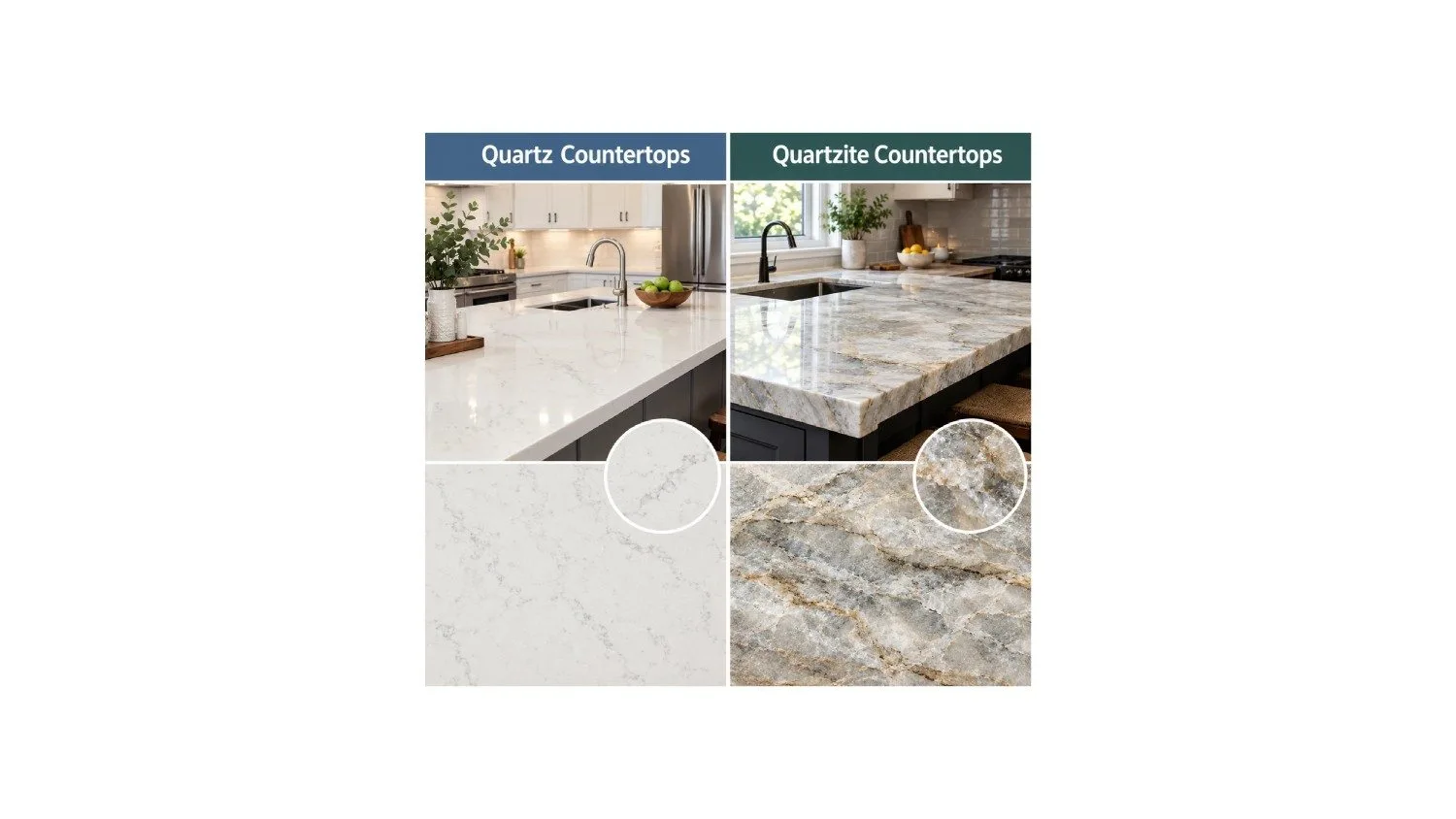
Looks are often the deciding factor in quartz vs quartzite countertops. Quartz gives you control. You can pick solid colors, subtle speckles, or bold marble-look veining, and the slab will match your sample. Quartzite gives you nature’s art. No two slabs are the same, with flowing veins and movement that can’t be copied. Many people say once you notice the difference between real stone and engineered stone, it’s hard to un-see it.
Both come in polished, honed (matte), and leathered (textured) finishes. Quartz finishes are set at the factory and can’t be changed. With quartzite, choose your slab in person, since the sample you see in a showroom may not match your actual slab.
5. Cost
Price is a big part of any quartz vs. quartzite countertops decision, and prices overlap a lot. Most installed countertops in both materials fall between about $55 and $150 per square foot. Quartz covers the whole range, while quartzite usually sits in the upper half and can go well above $200 per square foot for rare colors like blues.
| Kitchen size | Quartz (installed) | Quartzite (installed) |
|---|---|---|
| Small (30 sq ft) | About $1,650 to $4,500 | About $2,250 to $6,000+ |
| Average (50 sq ft) | About $2,750 to $7,500 | About $3,750 to $10,000+ |
| Large (80 sq ft) | About $4,400 to $12,000 | About $6,000 to $16,000+ |
Rough estimates. Waterfall edges, integrated sinks, thick edges, and complex layouts add cost.
Why quartzite costs more: It must be quarried, shipped from overseas, and cut with special diamond tools, often using computer-guided saws and waterjets. Because it’s so hard, it takes longer to cut and polish. Slab waste from matching veins also adds cost. High-end quartz brands, however, can cost as much as mid-range quartzite.
6. Maintenance and Cleaning
| Task | Quartz | Quartzite |
|---|---|---|
| Daily cleaning | Mild dish soap and warm water | pH-neutral stone cleaner or mild soap and water |
| Avoid | Scouring pads, bleach, oven cleaner, harsh chemicals, permanent markers | Acidic or abrasive cleaners, vinegar, bleach |
| Sealing | Never | About every 1 to 3 years |
| Spills | Wipe up anytime | Wipe up quickly, especially oil, wine, and acids |
7. Outdoor Use
For outdoor use, quartzite vs quartz countertops isn’t close. Quartzite is the clear choice for outdoor kitchens and sunny spots. The UV rays in sunlight can break down the resin in quartz, causing it to fade or turn yellow. Most quartz makers don’t recommend outdoor use, and quartz is also a poor choice around fireplaces because of heat.
8. Resale Value
Both are premium countertops that buyers love. Natural stone like quartzite often carries extra appeal in luxury homes, while quartz is a strong, safe choice for most homes thanks to its clean look and easy care.
What Is the Downside of Quartzite?
Every fair comparison of quartz vs quartzite countertops should cover the drawbacks. Before you fall in love with a slab, know them:
- Sealing: Most quartzite needs sealing every 1 to 3 years.
- Edge chips: It’s brittle, so edges and corners can chip if struck.
- Higher cost: Material and fabrication usually cost more.
- Mislabeled stone: Some “quartzite” is really marble or dolomite, which scratches and etches more easily.
- Limited colors: Mostly whites, grays, beiges, and some rare colors at premium prices.
- Weight: Heavy slabs need strong cabinets and skilled installers.
- Harder to repair: Chips can be filled, but color matching natural stone takes skill.
How to Spot Fake Quartzite
This is one of the most important parts of comparing quartzite vs quartz countertops. Some stones sold as “quartzite,” or as “soft quartzite,” are actually marble or dolomite. A well-known example is Fantasy Brown, often sold as quartzite but actually a dolomitic marble. It’s harder than typical marble but softer than true quartzite. If you pay quartzite prices for marble, you may get etching and scratches you didn’t expect.
Ask for a sample and do these simple tests:
- Glass test: Press the sharp edge of a sample firmly across a piece of glass. True quartzite is harder than glass and will scratch it easily. Marble won’t.
- Knife or scratch test: Try to scratch the sample with a steel knife or a nail. True quartzite won’t scratch. Marble and dolomite will show a mark.
- Acid test: Put a few drops of lemon juice or vinegar on the sample and wait several minutes. Wipe it off and look at the surface in the light. If a dull spot (etch mark) appears, it’s likely marble.
Also, ask the supplier directly: “Is this natural quartzite, dolomite, marble, or engineered quartz?” Names on slabs can be confusing, so always check.
Is Taj Mahal Quartz or Quartzite?
Taj Mahal is a natural quartzite from Brazil, known for its soft white and warm beige tones with gentle gold veining. It’s one of the most popular quartzites because it’s very dense, resists stains well, and rarely needs sealing. Some quartz makers also sell engineered quartz designs inspired by its look, so always ask which one you’re buying.
Is Quartz Safe? The Silica Dust Concern
Engineered quartz has been in the news because cutting and grinding it creates dust with very high levels of crystalline silica. Breathing that dust can cause silicosis, a serious and sometimes fatal lung disease. Health and safety agencies have raised alarms about rising cases among countertop fabrication workers, especially where slabs were cut dry without proper dust control. Australia banned engineered stone starting in July 2024, and some U.S. states, including California, have added stricter workplace rules.
What this means for homeowners: Once your countertop is installed, it’s considered safe to use. The risk is to the workers who cut it. Natural quartzite is also high in silica, so the same safe-cutting rules apply. Choose a fabricator who uses wet cutting, dust collection, and proper respirators.
Why Is Quartz in Decline?
Quartz is still one of the most popular countertops, but its growth has slowed. Reasons include the silica safety concerns and bans in some places, more buyers wanting the unique look of natural stone like quartzite, and the rise of other options like large porcelain slabs and newer engineered surfaces with less silica.
Quartz vs Quartzite vs Granite
| Feature | Quartz | Quartzite | Granite |
|---|---|---|---|
| Type | Engineered | Natural | Natural |
| Hardness (Mohs) | About 7 | About 7 to 8 | About 6 to 6.5 |
| Heat resistance | Low to moderate | High | High |
| Sealing | Never | Every 1 to 3 years | Every 1 to 2 years |
| Look | Uniform; any style | Marble-like veining | Speckled or flecked patterns |
| Installed cost (per sq ft) | About $55 to $150 | About $75 to $200+ | About $40 to $100+ |
Adding granite to the quartz vs quartzite countertops comparison helps many shoppers decide. Granite is often the budget-friendly natural stone pick. Quartzite gives a softer, marble-like look with granite-level toughness. Quartz offers the easiest care.
What Is the Best Stone for Kitchen Countertops?
There’s no single winner, which is why quartzite countertops vs quartz is such a common search. The best stone depends on how you cook, how much care you want to give, and the look you love:
- Best for easy care: Quartz
- Best natural stone for busy cooks: Quartzite or granite
- Best marble look without marble’s problems: Quartzite, or marble-look quartz
- Best budget natural stone: Granite
- Best for outdoor kitchens: Quartzite or granite
Quartz Countertops vs Quartzite: Which Should You Choose?
Here’s a simple way to settle quartz vs quartzite countertops for your home.
| Choose quartz if you… | Choose quartzite if you… |
|---|---|
| Want a low-maintenance counter that never needs sealing | Want real, one-of-a-kind natural stone |
| Have young kids and lots of spills | Cook often and set down hot pans |
| Want a consistent color or a solid white | Love dramatic, natural veining |
| Have a tighter budget | Have a bigger budget and want premium value |
| Are doing an indoor kitchen or bathroom | Are building an outdoor kitchen |
In the quartz countertops vs quartzite debate, many designers also suggest mixing them: quartzite on a showpiece island and quartz on the hard-working perimeter counters.
Frequently Asked Questions
What is the main difference in quartz vs quartzite countertops?
Quartz is an engineered stone made from crushed quartz, resin, and pigments. Quartzite is a 100% natural stone formed from sandstone under heat and pressure. Quartz is easier to care for, while quartzite handles heat better and has unique natural veining.
Is quartzite vs quartz countertops a big price difference?
It can be. Quartzite usually costs more, but prices overlap. A mid-range quartzite and a high-end quartz can cost about the same.
Which is more expensive, quartz or quartzite?
Quartzite is usually more expensive, often about $75 to $200+ per square foot installed, compared with about $55 to $150 for quartz. High-end quartz can cost as much as mid-range quartzite.
Can I put a hot cup of coffee on quartz?
Yes. A hot coffee mug is fine on quartz. The risk comes from very hot pots, pans, and baking dishes, which can scorch the resin. Always use a trivet for cookware.
What is the downside of quartzite?
Quartzite needs sealing, can chip on edges, usually costs more, has fewer color choices, and is sometimes confused with softer marble. Test samples before you buy.
Is quartzite harder than quartz?
Yes, slightly. Quartzite rates about 7 to 8 on the Mohs scale and quartz about 7. But quartz’s resin makes it less likely to chip.
Does quartzite stain?
It can if it isn’t sealed, because it’s porous. Seal it at installation and about every 1 to 3 years, and wipe up oil, wine, and coffee quickly.
Do quartz countertops need to be sealed?
No. Quartz is non-porous and never needs sealing.
Quartz countertops vs quartzite: which is better for a busy family kitchen?
Quartz is usually better for busy kitchens with kids because it resists stains, never needs sealing, and chips less. Quartzite is a good choice for families who cook a lot with hot pans and don’t mind sealing.
Is Taj Mahal quartz or quartzite?
Taj Mahal is a natural quartzite from Brazil. It’s dense and rarely needs sealing. Some engineered quartz designs copy its look, so ask your supplier which one you’re getting.
Why is quartz in decline?
Quartz is still popular, but growth has slowed due to silica dust safety concerns for fabrication workers, bans in places like Australia, more interest in natural stone, and new alternatives like porcelain slabs.
Final Thoughts
When it comes to quartz vs quartzite countertops, neither one is better for everyone. Quartz is the easy-care choice: non-porous, stain resistant, never needs sealing, and available in almost any color. Quartzite is the natural beauty: harder, much better with heat, great outdoors, and truly one-of-a-kind, but it needs sealing and costs more.
Whether you search quartz vs quartzite countertops or quartzite vs quartz countertops, the answer comes down to you. Think about how you cook, how much maintenance you’re willing to do, and the look you love. If you choose quartzite, test your sample to make sure it’s the real thing. If you choose quartz, keep trivets handy. Either way, you’ll enjoy a beautiful, long-lasting countertop for years.