
Single Hung vs Double Hung Windows: Differences, Cost, Pros and Cons (complete guide)
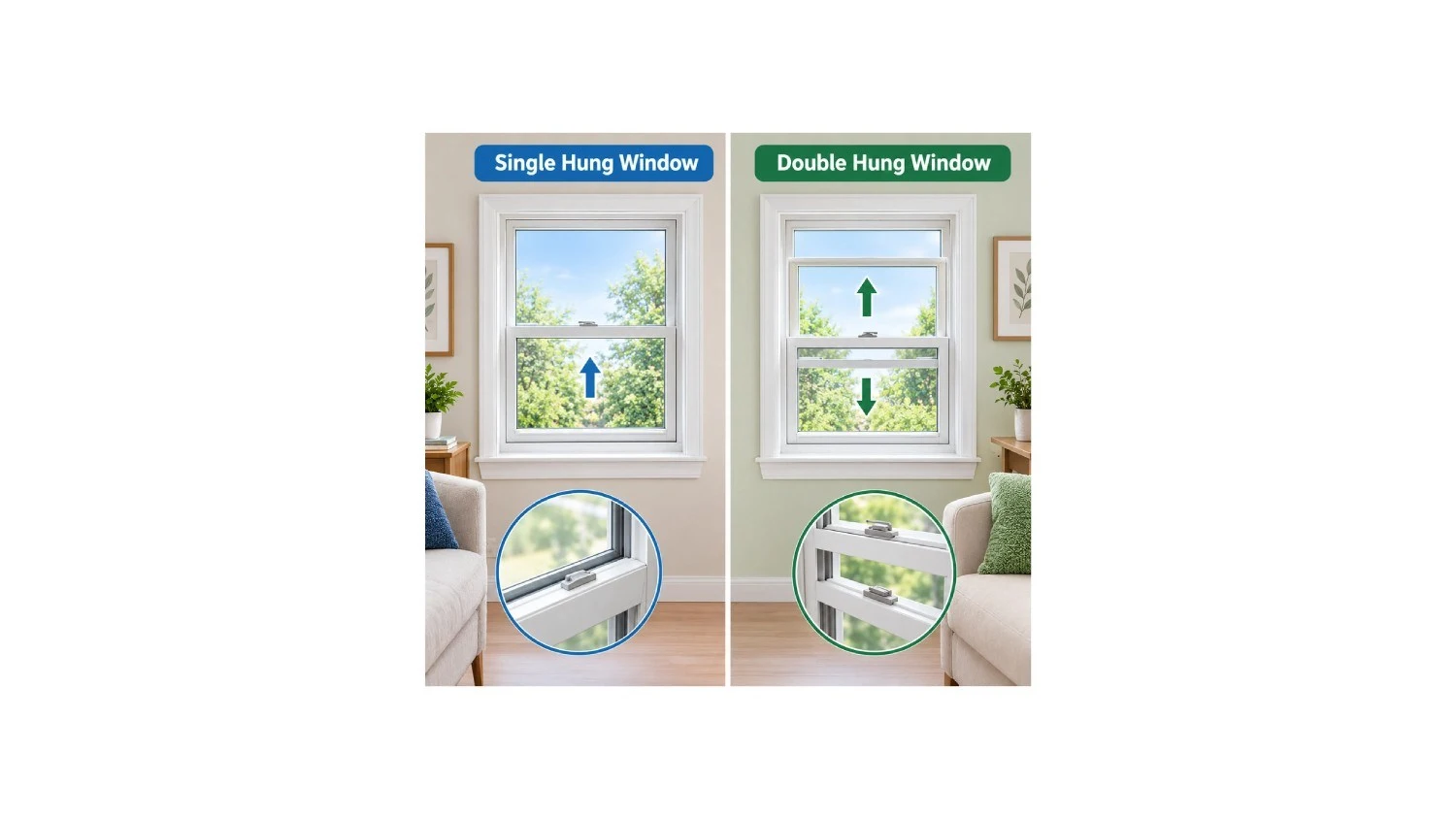
Single hung and double hung windows are two of the most common window styles in American homes. From the street, they look almost exactly the same: two glass panels, one stacked above the other, inside a tall rectangular frame. The big difference is how they open. On a single hung window, only the bottom panel moves. On a double hung window, both the top and bottom panels move, and most of them tilt in for easy cleaning.
That one difference changes the price, how air flows through your home, how easy the windows are to clean, and even how safe they are for kids. In this guide, we compare single hung vs double hung windows in plain, simple words. You’ll see how each one works, what they cost, how they compare on energy efficiency, and the real pros and cons of each. We’ll also show you which style fits each room, how to tell which type you already have, and how both compare to casement and sliding windows. By the end, you’ll know exactly which window is right for your home and budget.
Quick answer: A single hung window has a fixed top sash and a bottom sash that slides up. It costs less, often about 10% to 25% less per window, and has fewer parts that can leak or break. A double hung window has two sashes that both slide up and down and usually tilt inward. It costs more but gives better airflow, easier cleaning, and a safer way to ventilate around kids. Choose single hung for first-floor rooms and tight budgets. Choose double hung for upper floors, kitchens, bathrooms, and homes with small children.
Single Hung vs Double Hung Windows at a Glance
Here’s a quick side-by-side look at double hung vs single hung windows.
| Feature | Single hung | Double hung |
|---|---|---|
| Which sashes move | Bottom only; top is fixed | Both top and bottom |
| Tilt-in cleaning | Bottom sash only on some models | Usually both sashes |
| Ventilation | One opening (bottom) | Top, bottom, or both |
| Price per window (installed) | About $300 to $800 (vinyl) | About $450 to $1,100 (vinyl) |
| Energy efficiency | Slightly tighter seal in theory | Very close when well built and locked |
| Moving parts | Fewer | More (balances, tilt latches) |
| Child safety | Opens only at the bottom | Can open top only, out of reach |
| Screen | Half screen (bottom) | Full screen to use top opening |
| Best for | First floors, budget projects, rentals | Upper floors, kitchens, baths, family homes |
Price ranges are rough national estimates for standard vinyl replacement windows. Wood, fiberglass, and custom sizes cost more.
What Is a Single Hung Window?
To understand single hung vs double hung windows, start with how each one is built. A single hung window has two sashes (the framed glass panels). The top sash is fixed in place and doesn’t move. The bottom sash slides up to open and down to close. Many newer single hung windows let the bottom sash tilt in for cleaning, but the top sash stays put.
Single hung window pros:
- Lower cost to buy and install
- Fewer moving parts, so less can wear out
- The fixed top sash seals tightly, with fewer potential air leak points
- Simple to use and maintain
- Often a strong choice for builders, rentals, and big multi-window projects
Single hung window cons:
- Less control over airflow; you can only open the bottom
- Hard to clean the outside of the top glass, especially on upper floors
- Opening the bottom sash puts the open area within reach of small children
- If the top glass breaks, repairs can be more involved
What Is a Double Hung Window?
The other half of the double hung vs single hung windows comparison is the double hung style. A double hung window also has two sashes, but both slide up and down independently. You can lower the top sash, raise the bottom sash, or open both at once. Most modern double hung windows also let both sashes tilt inward, so you can clean both sides of the glass from inside your home.
Double hung window pros:
- Better ventilation control: open the top to let hot air out and the bottom to bring cool air in
- Easy cleaning from inside, which is a big plus on second and third floors
- Safer ventilation around kids and pets by opening only the top sash
- Either sash can usually be removed or replaced on its own
- Classic look that fits traditional and historic homes
Double hung window cons:
- Costs more, usually about $50 to $250+ more per window
- More moving parts (sash balances, tilt latches) that can wear out
- Two moving sashes mean more weatherstripping that must stay in good shape
- If not locked properly, the top sash can slip down slightly and leak air
Single Hung vs Double Hung Windows: Head-to-Head Comparison
1. Cost
Price is the biggest difference in single vs double hung windows, and the main reason people choose single hung. With one fixed sash, they’re simpler to build and have fewer parts.
| Frame material | Single hung (installed, per window) | Double hung (installed, per window) |
|---|---|---|
| Vinyl | About $300 to $800 | About $450 to $1,100 |
| Aluminum | About $250 to $700 | About $400 to $900 |
| Fiberglass | About $600 to $1,200 | About $700 to $1,500 |
| Wood or wood-clad | About $700 to $1,400 | About $800 to $1,800+ |
Rough 2026 national ranges. Size, glass package, brand, and installation type (insert vs. full-frame) change the price.
How the savings add up: A typical home has about 15 to 20 windows. Saving $75 to $150 per window by choosing single hung could save about $1,100 to $3,000 on a whole-house project. Many homeowners split the difference: single hung on the first floor, double hung upstairs and in kitchens and baths.
2. Energy Efficiency
Energy efficiency is a common question in single hung vs double hung windows. You’ll often read that single hung windows are more energy efficient because the top sash is permanently sealed. In theory, that’s true: fewer moving parts means fewer gaps for air to slip through.
In practice, the difference between single hung vs double hung windows is small when both are well built and properly installed. Most of a window’s energy performance comes from:
- The glass package: double- or triple-pane glass, Low-E coatings, and argon or krypton gas fill
- The frame material: vinyl, fiberglass, and wood insulate better than plain aluminum
- Installation quality: gaps around the frame leak more air than the window itself
- Keeping it locked: locking a double hung window pulls both sashes tight against the weatherstripping
What to compare: Look at the window’s energy rating label. Check the U-factor (lower is better at keeping heat in), the solar heat gain coefficient or SHGC (lower is better in hot climates), and the air leakage rating (lower is better; many good windows test at 0.3 or below). Windows that earn ENERGY STAR certification for your climate zone are a safe bet.
3. Ventilation and Airflow
When you compare single hung vs double hung windows for airflow, double hung wins. Hot air rises, so lowering the top sash lets warm, stale air escape near the ceiling, while raising the bottom sash pulls cooler air in low. This creates a natural airflow loop that can cool a room without running the AC on mild days. This is especially useful in kitchens and bathrooms, where heat, cooking smells, and moisture build up.
Single hung windows only open at the bottom, so you have less control. Both styles open about the same total amount, roughly half the window, but double hung lets you choose where.
4. Cleaning and Maintenance
Cleaning is where a single hung vs double hung window comparison really tilts. Double hung windows are much easier to clean. Both sashes tilt inward, so you can wash the outside glass from inside the house. That’s a huge advantage on second floors, where cleaning the outside of a single hung’s fixed top sash may require a ladder or a pro.
For maintenance, single hung windows have the edge with fewer moving parts. Double hung windows rely on sash balances (springs or cords that hold the sashes up) and tilt latches on both sashes. These can wear out over time but are usually inexpensive to replace.
5. Safety for Kids and Pets
Safety is an important part of the single hung vs double hung windows decision. Window falls are a real risk for young children. With a double hung window, you can open only the top sash, letting air in while keeping the opening out of reach. With a single hung window, the only opening is at the bottom.
For extra safety with either style:
- Install window opening control devices or stops that limit openings to under 4 inches.
- Don’t rely on screens; they keep bugs out, not children in.
- Keep furniture kids can climb away from windows.
Bedroom egress rules: Building codes require bedroom windows to be large enough for emergency escape. Under common U.S. codes, the net clear opening must usually be at least 5.7 square feet (5.0 on the ground floor), at least 24 inches high and 20 inches wide, with the sill no more than 44 inches above the floor. Because both hung styles open only about half their size, bedroom windows must be big enough to meet these rules. Check your local code before ordering.
6. Durability and Weather Resistance
In storm-prone areas, single hung vs double hung windows perform a little differently. Single hung windows have fewer moving parts and a fixed top sash, which can make them a bit sturdier against wind-driven rain. That’s one reason single hung windows are popular in hurricane-prone areas, where impact-rated single hung units are common. Quality double hung windows also perform well when built with strong frames and good weatherstripping. Check the design pressure (DP) rating if you live in a stormy or coastal area.
7. Looks and Curb Appeal
When it comes to looks, double hung vs single hung windows are nearly a tie. From the outside, they look almost identical. Both come in the same sizes, grid patterns, colors, and frame materials, so you can mix them in the same house without anyone noticing. From inside, some single hung windows have a slightly different meeting rail where the sashes meet. Double hung windows are often preferred for historic homes because they match the original style.
8. Screens
Single hung windows usually come with a half screen covering the bottom opening. Double hung windows need a full screen if you want to open the top sash with bugs kept out. Full screens can make the view a bit hazier and cost slightly more.
What Are the Disadvantages of Single Hung Windows?
- Limited ventilation, since only the bottom opens
- The outside of the top glass is hard to clean on upper floors
- The only opening is low, where kids can reach it
- Less flexible for rooms that need lots of airflow
What Are the Disadvantages of Double Hung Windows?
- Higher price per window
- More parts that can wear out, like balances and tilt latches
- More weatherstripping to maintain, with possible small air leaks as it ages
- Must be locked fully to seal tightly
- Full screens can slightly reduce the view
Which Is More Expensive, Single or Double Hung Windows?
In any double hung window vs single price check, double hung windows are more expensive. Expect to pay about 10% to 25% more, often around $50 to $250 or more per window, depending on size, material, and brand. The extra cost covers the second moving sash, extra balances, tilt hardware, and locks.
Single vs Double Hung Windows: Which Is Best for Each Room?
Use this table to choose between single vs double hung windows room by room.
| Room or situation | Better choice | Why |
|---|---|---|
| First-floor living rooms, bedrooms, offices | Single hung | Lower cost; easy to clean from outside |
| Second-floor and higher rooms | Double hung | Tilt-in cleaning from inside |
| Kitchens | Double hung | Vents heat and cooking odors; easy to clean over the sink |
| Bathrooms | Double hung | Top opening vents moisture with more privacy |
| Kids’ rooms and nurseries | Double hung | Open only the top for safer airflow |
| Hallways, closets, laundry and utility rooms | Single hung | Simple ventilation needs; saves money |
| Rentals and new builds on a budget | Single hung | Lower cost per window |
| Historic or traditional homes | Double hung | Matches original style |
| Hurricane or high-wind areas | Single hung (impact-rated) | Fewer moving parts; often higher ratings for the price |
How Do I Know If My Window Is Single Hung or Double Hung?
- Try to lower the top sash. Unlock the window and push down on the top sash. If it slides down, it’s double hung. If it doesn’t move, it’s single hung.
- Look for tilt latches on the top sash. Double hung windows usually have small latches or buttons on the top rail of both sashes. Single hung windows only have them on the bottom sash, if at all.
- Check the screen. A half screen covering only the bottom usually means single hung. A full-height screen often means double hung.
- Look at the tracks. Double hung windows have visible tracks and balances above the top sash that let it move.
Tip: Old double hung windows that were painted shut can act like single hung windows. If the top sash won’t move but has latches, it may just be stuck.
Single Hung vs Double Hung vs Casement and Sliding Windows
Many shoppers comparing single hung vs double hung windows also look at casement and sliding styles.
| Feature | Single hung | Double hung | Casement | Sliding |
|---|---|---|---|---|
| How it opens | Bottom slides up | Both sashes slide | Swings out with a crank | Slides sideways |
| Ventilation | About 50% of window | About 50%, top or bottom | Nearly 100%; catches breezes | About 50% |
| Air tightness | Good | Good | Excellent (presses closed against seals) | Fair to good |
| Cost | Lowest | Low to medium | Higher | Low |
| Best for | Budget projects | Upper floors, family homes | Hard-to-reach spots, max airflow, energy efficiency | Wide openings, modern homes |
Many homeowners planning a “forever home” say that if your budget allows, casement and awning windows seal tighter than any sliding style, including hung windows. They cost more and have crank hardware, but they’re worth comparing if energy efficiency is your top goal.
How Long Do Hung Windows Last?
Quality vinyl single hung and double hung windows typically last about 20 to 40 years. Wood windows can last even longer with regular painting and care. Double hung windows may need new sash balances or weatherstripping every 10 to 20 years, which is a fairly cheap repair. Signs you need replacements include drafts, foggy glass between panes, sashes that won’t stay up, rot, and windows that are hard to open.
Tips for Buying Single or Double Hung Windows
- Compare energy ratings, not just the window style.
- Ask about installation type: insert (pocket) replacement is cheaper; full-frame replacement fixes rot and leaks around the frame.
- Check the warranty on glass seals, hardware, and labor.
- Look at the balances and locks on double hung windows; sturdy hardware lasts longer.
- Mix styles to balance cost and convenience.
- Get several quotes and make sure each includes the same glass package and installation details.
- Check for rebates and tax credits for energy-efficient windows in your area.
Frequently Asked Questions
What is the main difference in single hung vs double hung windows?
On a single hung window, only the bottom sash moves and the top is fixed. On a double hung window, both sashes slide up and down, and most tilt inward for cleaning.
Which is more expensive, single or double hung windows?
Double hung windows usually cost about 10% to 25% more, often $50 to $250 or more per window, because they have a second moving sash and more hardware.
Are single hung windows more energy efficient than double hung?
Slightly, in theory, because the top sash is sealed. But when both are well built, properly installed, and locked, the difference is small. The glass package and installation matter much more.
What are the disadvantages of single hung windows?
They offer less ventilation control, the outside of the top glass is hard to clean from inside, and the only opening is low, where kids can reach it.
What are the disadvantages of double hung windows?
They cost more, have more parts that can wear out, rely on more weatherstripping, and must be locked fully to seal tightly.
How do I know if my window is single hung or double hung?
Unlock the window and try to lower the top sash. If it moves, it’s double hung. You can also look for tilt latches on the top sash and check whether the screen is half or full height.
Is double hung window vs single hung better for a second floor?
Double hung is usually better for upper floors because both sashes tilt in, so you can clean the outside glass safely from inside.
Is a single hung vs double hung window better for a rental property?
Single hung is usually better for rentals. It costs less, has fewer parts that tenants can break, and is simple to maintain.
Can I mix single and double hung windows in my house?
Yes. They look nearly the same from outside, so many homeowners use single hung on the first floor to save money and double hung upstairs and in kitchens and bathrooms.
Do single hung windows tilt in for cleaning?
Many newer single hung windows have a bottom sash that tilts in, but the top sash stays fixed. Only double hung windows let you tilt both sashes.
Final Thoughts
When comparing single hung vs double hung windows, there’s no single winner, whether you call it single vs double hung windows or double hung vs single hung windows. Single hung windows are the budget-friendly, low-maintenance choice, with a fixed top sash that seals well and fewer parts to wear out. Double hung windows cost a bit more but give you better airflow, easy tilt-in cleaning, and safer ventilation for families.
In the double hung vs single hung windows debate, the smartest plan for many homes is a mix: single hung on the first floor and in simple spaces, double hung upstairs and in kitchens, bathrooms, and kids’ rooms. Whatever you choose, focus on quality glass, good energy ratings, and professional installation. Those matter more for comfort and energy savings than the window style itself.
